

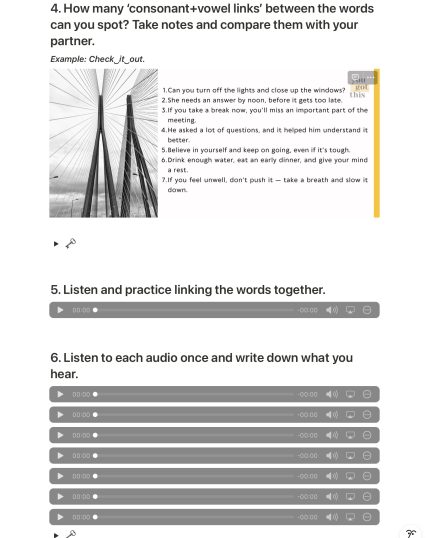
Pronunciation 3. Catenation.
In this lesson, your students will:
- Try themselves at decoding tricky pairs of phrases
- Notice and identify linking in phrases, sentences, and texts.
- Practice the “great and terrible” Flap T sound
- Reduce “and” naturally for flow and speed.
- Break down fast speech and imitate authentic rhythm and tone.
- Complete quizzes for better noticing skills
- Reinforce the features naturally through songs.
This lesson contains up to 20 interactive exercises that raise awareness of how native speakers connect words in real-life speech, identify and understand catenation, and improve listening skills and decoding ability through audio tasks and guided analysis.
Features: Catenation, Flap t, weak ‘and’ in Connected Speech
Additional resources: Wordwall

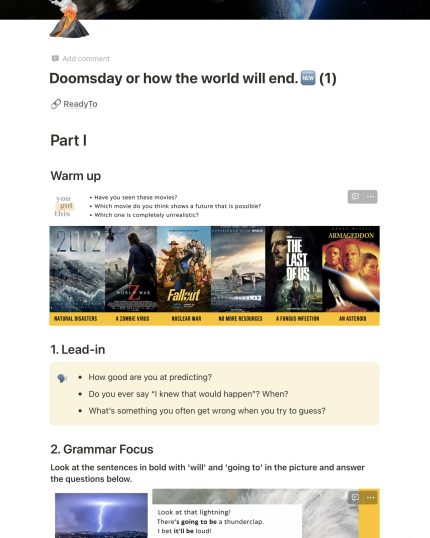
Doomsday. Future Tenses
In this lesson, your students will:
- Make future predictions based on visuals, context, and emotions
- Read wild doomsday theories and decide which one sounds the most real
- Share their opinions on future world events and personal life milestones
- Listen to authentic audio stories filled with tension and emotion, and make real-time predictions
- Rank survival items, giving reasons and predictions
This lesson includes up to 15 exercises that work together to clarify the difference between will and going to for predictions and evidence, build confidence using future forms in context, and spark imagination and meaningful conversation.
Grammar: ‘will’ and ‘going to’ for predictions
Additional resources: WordWall, LearningApps, Quizlet
Speaking: Film Industry
In this speaking club, your students will:
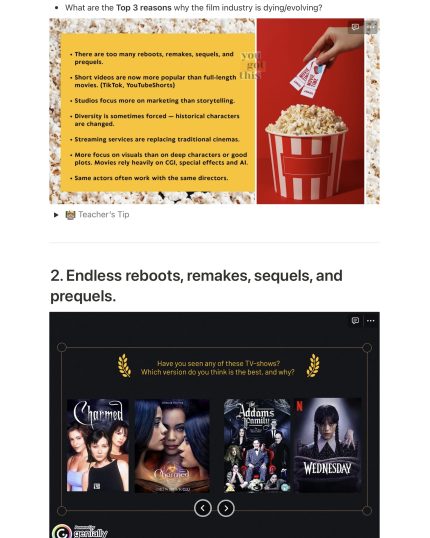
- Dive into hot-button trends like TikTok, reboots, and CGI to debate whether the film industry is evolving or losing its spark
- Discuss how they feel about constant reboots, remakes, prequels and sequels.
- Debate the pros and cons of reboots, long vs short content, and streaming
- Discuss diversity and race-swapping in Hollywood and its cultural impact
- Analyze what makes an Oscar-worthy performance
Tired of the same old movie talk? This lesson dives deep into the real changes shaping today’s film industry — from TikTok to diversity debates and Oscar drama. Your students will explore what’s evolving, what’s collapsing, and what’s worth celebrating in modern cinema.

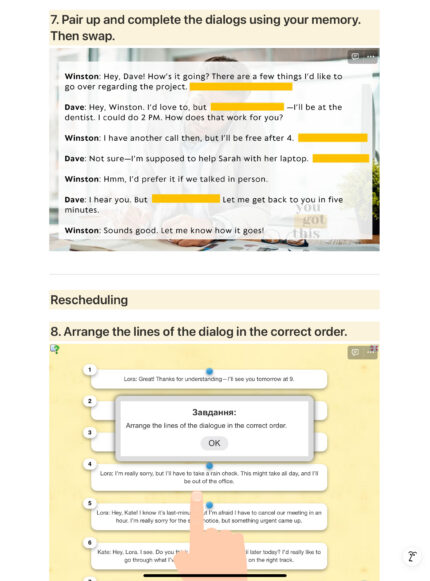
Scheduling Meetings
In this lesson, your students will:
- Examine the use of “-ish” in everyday speech.
- Match and complete realistic meeting dialogues, practicing how to schedule or rearrange calls.
- Rephrase common expressions used in business settings and casual conversations.
- Practice the pronunciation of key rescheduling phrases for natural, automatic use in conversation.
- Engage in functional dialogues about arranging and adjusting meetings using provided frameworks and visuals.
This lesson contains 15 interactive exercises and helps develop students’ functional language for scheduling and rescheduling events, raise awareness of nuanced time expressions, and encourage spoken fluency and pronunciation practice through drilling, rephrasing, and role-play.
Vocabulary: the -ish suffix, last-minute, I can’t make it 1 p.m., etc
Additional resources: WordWall, LearningApps, Quizlet

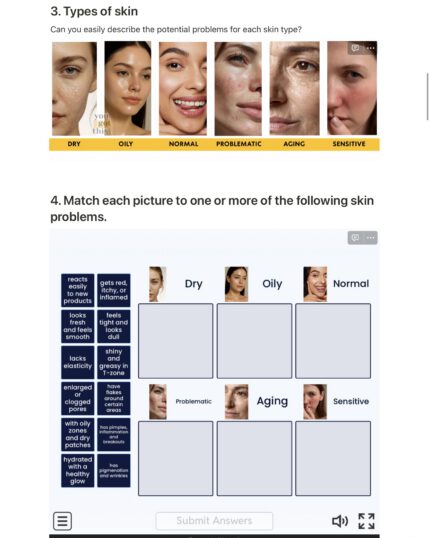
Skincare Routine
In this lesson, your students will:
- Learn key skincare-related vocabulary in context
- Understand and summarize a 5-step skincare routine
- Match product instructions to beauty items and discuss their use
- Reflect on their own habits and share opinions
- Compare natural aging and cosmetic procedures
- Debate ethical beauty issues like cruelty-free products and influencer marketing
- Drill personal skincare routine steps to be able to explain how beauty products work
This lesson includes up to 20 exercises that help students build vocabulary related to skincare steps, products, and ingredients, and practice giving personal opinions and discussing consumer choices.
Vocabulary: skincare steps, products, and ingredients
Additional resources: WordWall, Quizlet, Learning Apps

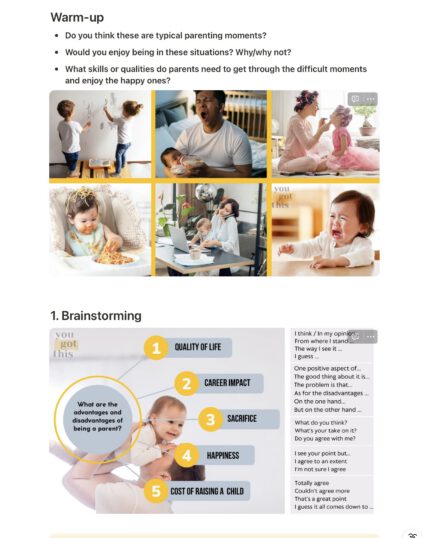
Speaking: Parenting
In this speaking club, your students will:
– Share reactions to typical parenting situations: both heartwarming and chaotic
– Learn and use key vocabulary related to parenting
– Explore cultural expectations of moms and dads, and reflect on shifting roles
– Talk through fun dilemma questions and challenging teen behaviors
– Discuss the emotional side of parenting shown in popular TV series
– Reflect on what kind of parent they are or could be, and what values matter most in raising a child

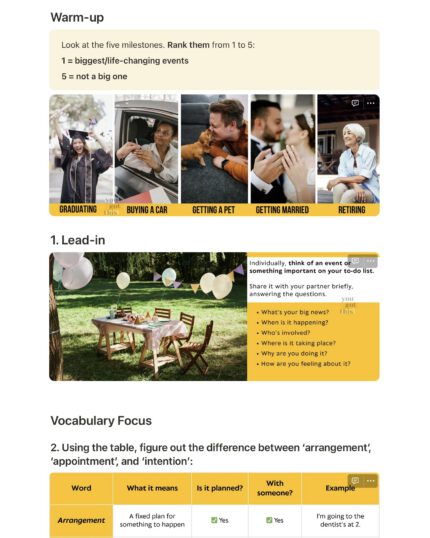
Important Events
In this lesson, your students will:
- Discover and compare how we talk about the future using ‘will’, ‘going to’, and Present Continuous
- Practice choosing the correct form through real-life examples and controlled exercises
- Personalize and discuss their own future plans, intentions, and decisions
- Engage in dialogues, reactions, and planning tasks to build fluency and natural conversation skills
- Reflect on milestones and life events using accurate grammar and vocabulary
This lesson includes 15 exercises that help students clearly distinguish between ‘will’, ‘going to’, and Present Continuous when talking about the future, and improve fluency and confidence in speaking about intentions, fixed plans, and spontaneous decisions using natural, spoken English.
Grammar: Future Forms (will, going to, Pres. Cont.)
Vocabulary: reacting to good news
Additional resources: WordWall, Quizlet, Learning Apps

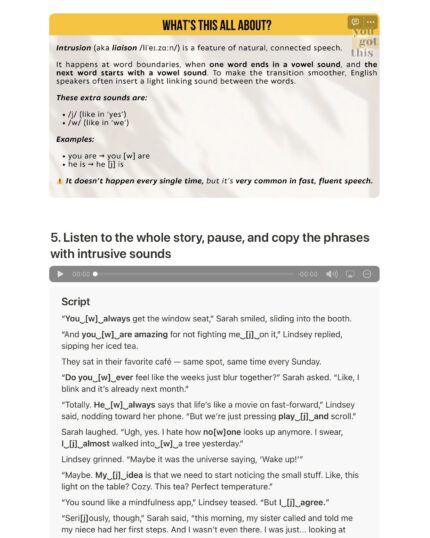
Pronunciation 2. Intrusion
In this lesson, your students will:
- Explore the topic of intrusion in connected speech
- Focus on audio decoding
- Learn to identify and detect intrusion through targeted listening activities
- Engage in various practice exercises
- Work with audio drills to polish pronunciation and listening accuracy
- Integrate the new material into speaking by discussing carefully designed conversation questions
This lesson contains 15 exercises to ensure maximum practice and build both awareness and confidence in real-life speech.
Features: intrusive /j/ and /w/ sounds in Connected Speech
Additional resources: Wordwall

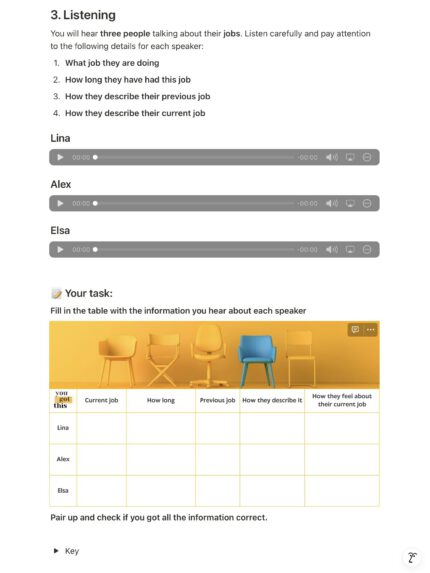
AI in the Workplace
In this lesson, your students will:
- Listen to people describe their jobs and compare them to past careers.
- Practice using job-related adjectives to describe different professions.
- Use the present perfect continuous with for and since to talk about how long an action has been happening.
- Talk about how technology and AI are changing the job market.
- Ask and answer “How long…?” questions in meaningful personal conversations.
- Reflect on which jobs are disappearing, staying, or becoming more rewarding in the future.
This lesson includes over 15 exercises that work together to develop listening, vocabulary, and grammar skills for discussing jobs and work experiences using the present perfect continuous.
Grammar: Present Perfect Continuous (for, since, how long)
Vocabulary: rewarding, emotionally draining, etc.
Additional resources: WordWall, Quizlet

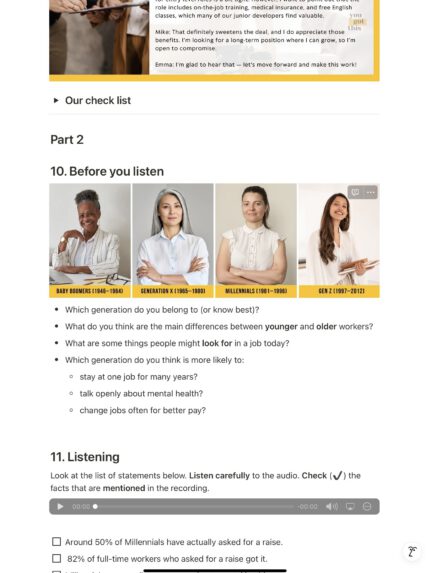
Negotiating Salary
In this lesson, your students will:
- Explore different attitudes to asking for a raise through real-life examples.
- Learn, practice, and memorize key phrases for salary negotiation and compromise.
- Compare workplace values across generations.
- Develop confidence in expressing expectations and discussing money tactfully.
- Use guided practice to build negotiation dialogs and give thoughtful advice.
This lesson includes 15 exercises that work together to enable students to use polite and confident language for negotiating salaries and benefits in job-related conversations.
Functional language: it’s not what I had in mind, I’m open to compromise, etc.
Vocabulary: meet you halfway, contribute, etc.
Additional resources: WordWall, LearningApps, Quizlet
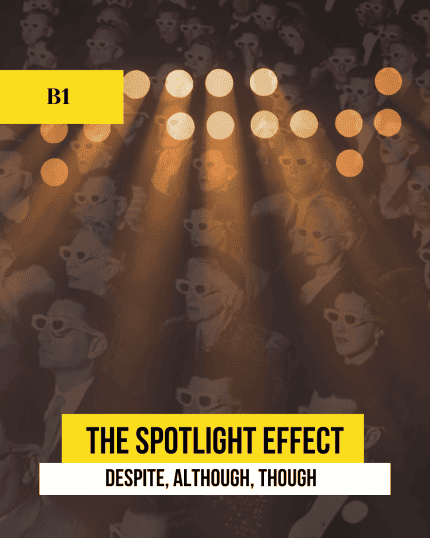
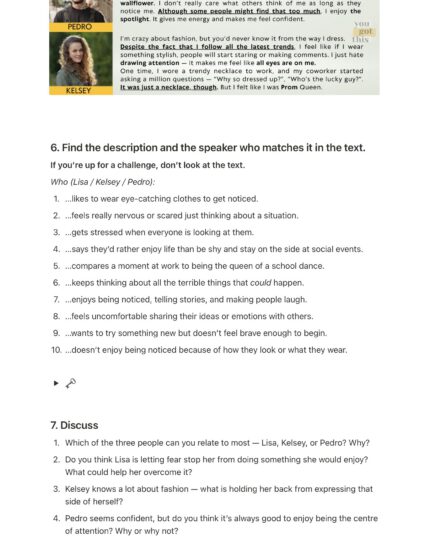
The Spotlight Effect
In this lesson, your students will:
- Listen for gist to identify what the Spotlight Effect is and what real-life examples are shared.
- Listen for detail to answer comprehension questions, using evidence from the text.
- Personalize the topic through reflective speaking questions about confidence and self-perception.
- Read a set of short character monologues and identify if they are related to the Spotlight Effect.
- Practice key expressions through sentence transformation.
- Focus on grammar, discovering the rules for contrast linkers in doing controlled practice activities.
- Use contrast language in personalized speaking prompts about resilience, setbacks, and proud moments.
This lesson includes up to 15 exercises that work together to develop students’ listening and reading skills for gist and detail in the context of self-consciousness. It also develops accuracy through guided practice of contrast linkers in context
Grammar: contrast linkers: (al)though, despite (the fact that)
Vocabulary: stand out, be a wallflower, etc
Additional resources: WordWall, LearningApps, Quizlet

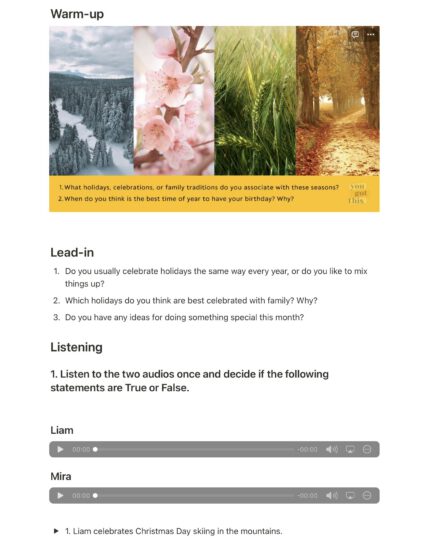
Holiday Celebrations
In this lesson, your students will:
- Practice listening for detail through stories about real holiday routines
- Review and confidently use prepositions of time (at, on, in) in meaningful contexts
- Learn to describe celebrations and personal traditions using natural phrases
- Explore and practice the structure “thinking of + -ing” for future plans
- Personalize grammar through storytelling, discussion, and real-life examples
- Build fluency through sentence correction, speaking drills, and engaging visuals
- Boost vocabulary and accuracy with interactive games and a fun grammar challenge
This lesson contains 12+ interactive exercises that develop students’ ability to accurately use prepositions of time (at, on, in) and the structure “thinking of + -ing” through the context of holidays and seasonal plans. It also provides practice in listening for gist and specific information and encourages spoken fluency through personalized discussions about holiday routines and plans.
Grammar: Prepositions of time / ‘thinking of’
Additional resources: Wordwall, Quizlet, LearningApps