

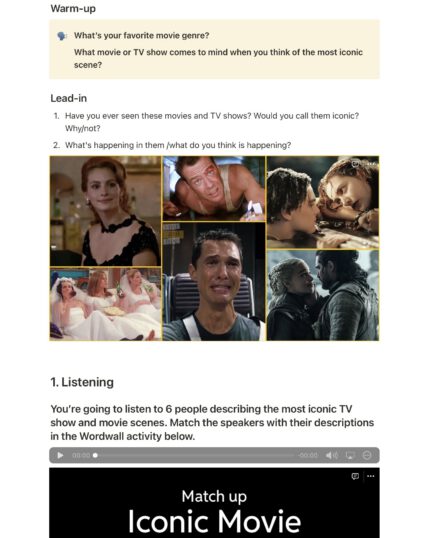
Iconic Movie Scenes
In this lesson, your students will:
- Explore and react to opinions about popular series using natural conversation.
- Practice and personalize vocabulary like grow on me, binge-watch, and not my thing.
- Compare Present Continuous for now vs around now in relatable contexts.
- Drill and use Present Continuous forms confidently in speaking.
- Describe real-time and current activities using rich, visual prompts.
- Reflect on their own viewing habits and practice fluency in discussions.
This lesson contains 15+ interactive exercises that provide clarification and controlled practice of the Present Continuous tense through the lens of iconic movie scenes. Students get the chance to speak about familiar and emotionally engaging films and series, using Present Continuous naturally alongside reaction language. They also review and activate a range of adjectives to describe emotional responses to what they watch.
Vocabulary: hilarious, gives me goosebumps, etc
Grammar: Present Continuous
Additional resources: Wordwall, Quizlet, LearningApps

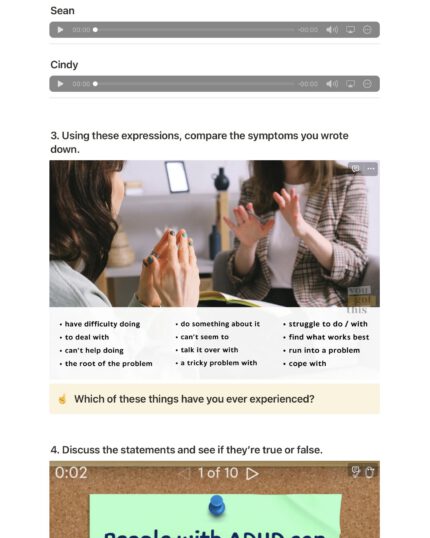
ADHD and Other Disorders
In this lesson, your students will:
- Learn what ADHD is and recognize common symptoms through real-life audio.
- Describe emotional and behavioral struggles in clear, natural English.
- Use key vocabulary to talk about challenges and coping strategies.
- Paraphrase and complete sentences with useful new expressions.
- Reflect on misconceptions and learn about related disorders.
- Speak more confidently about sensitive topics in a thoughtful way.
This lesson includes up to 15 exercises and aims to raise awareness of ADHD and similar disorders through relevant listening and speaking tasks.
Vocabulary: have difficulty, can’t help, talk it over, etc
Additional resources: LearningApps, Wordwall, Quizlet

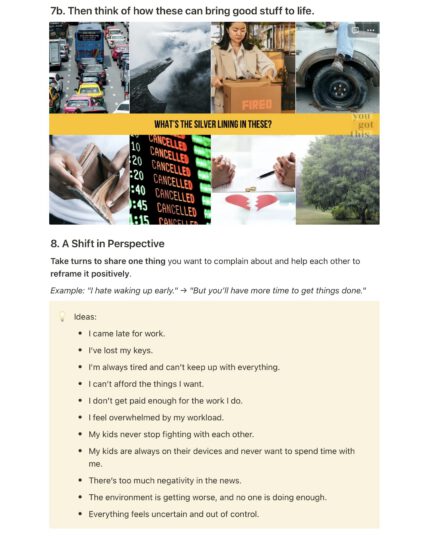
Speaking: Are We Never Satisfied?
Challenge your students to rethink happiness, moving beyond material desires and societal pressures. With thought-provoking discussions, games, and speaking cards, they’ll explore mindset shifts while improving fluency. Get this lesson now and inspire fresh perspectives!
In this lesson, your students will:
- Dive into the influence of social media on our desires.
- Explore the roots of jealousy.
- Pick up fun and useful vocabulary like Debbie Downer and see the silver lining.
- Watch a comedian’s hilarious take on human dissatisfaction.
- Play a game finding pros and cons in different situations.
- Bust common myths about happiness.
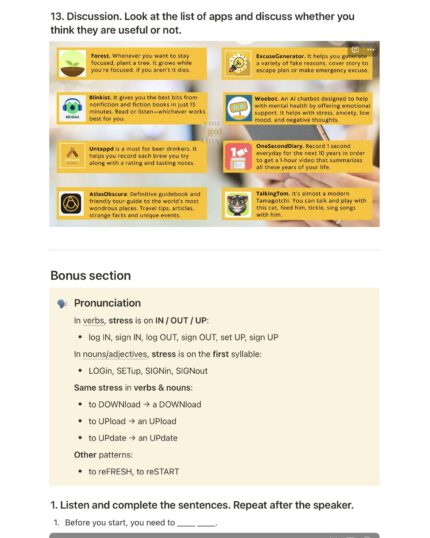
Essential Apps
In this lesson, your students will:
- Read about how people use apps to improve their daily lives.
- Explore the phrases “in order to,” “so that,” and “in order for somebody to.”
- Practice with five grammar exercises to master these phrases.
- Discuss the purpose of the most popular—and even the weirdest—apps!
- Enjoy the Bonus Section!
- Practice with the audio to perfect your pronunciation of words like: 💬 log in, 💬 comments, 💬 refresh.
This lesson contains up to 20 interactive exercises that help correctly use “in order to,” “so that,” and “in order for” to express purpose and develop fluency by discussing personal experiences with technology. As a bonus section: practicing pronunciation of phrasal verbs related to technology.
Grammar: clauses of purpose with in order to/for, so that
Additional resources: LearningApps, Wordwall, Quizlet

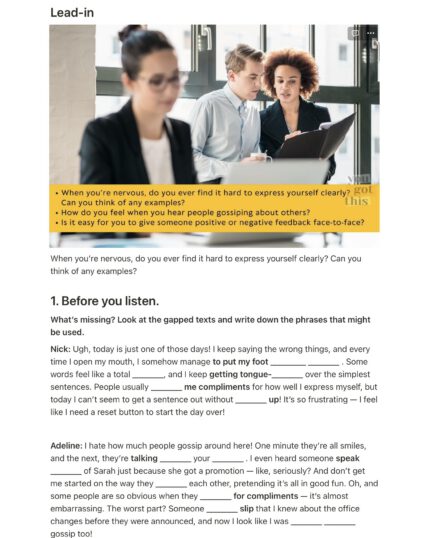
Talking Habits. Part 2
In this lesson, your students will:
- Predict natural expressions based on context before listening.
- Listen to short audio clips and complete gapped monologues using accurate vocabulary.
- Sort phrases into categories and match them with definitions to boost understanding and retention.
- Correct false definitions and clarify subtle differences in meaning.
- Practice sentence transformations and paraphrasing to build fluency.
- Apply expressions in real-time through sentence completion and open-ended prompts.
- Use target phrases in a creative game to encourage sharing and spontaneous speaking.
- Watch two short video clips and retell what happened using the lesson vocabulary.
- Reflect on personal experiences and engage in meaningful discussions using newly learned expressions.
This lesson contains up to 15 interactive exercises that familiarize and help students practice idioms related to communication in context through listening and speaking exercises, and encourage them to use the idioms to describe real-life situations or express personal experiences.
Vocabulary: put your foot in it, fish for compliments, etc
Additional resources: LearningApps, Wordwall, Quizlet
Tags: Listening, Speaking, Vocabulary, Functional Language, Discourse, Text-Based

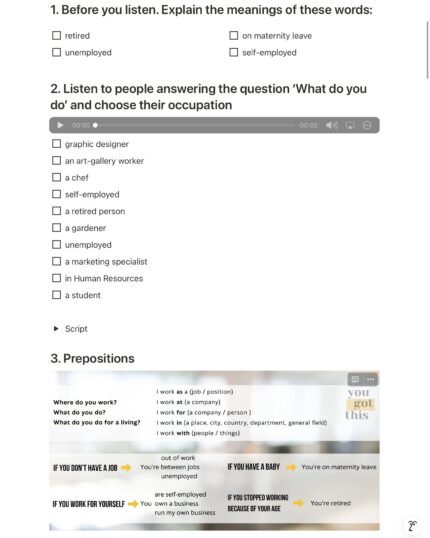
Work Experience
In this lesson, your students will:
- Discuss job-related vocabulary and clarify the difference between “What do you do?” and “What are you doing?”
- Listen to people talk about their work and identify occupations and work situations.
- Practice using correct prepositions with work-related verbs.
- Describe professions using structured language and real-life context.
- Learn to rephrase and upgrade job-related expressions using more natural vocabulary.
- Match job phrases with definitions and collocations to boost retention.
- Practice real-life phrases related to job hunting and work experience
- Share personal stories and reflect on what matters most in a job
- Answer open-ended discussion questions about values, motivation, and dream jobs.
This lesson contains up to 20 interactive exercises that develop students’ ability to discuss jobs and employment using appropriate vocabulary and grammar and provide controlled and freer speaking practice on job-related topics.
Vocabulary: on-the-job training, hand-on experience, etc
Grammar: Prepositions with work
Additional resources: Wordwall, Quizlet

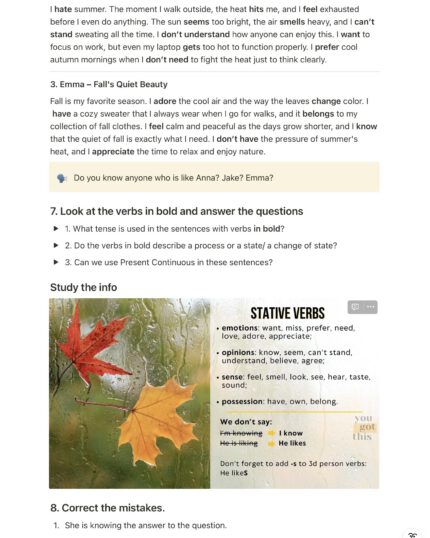
Seasonal Disorder
In this lesson, your students will:
- Explore what SAD is and how it affects people.
- Listen for symptoms in a psychologist’s talk and build confidence in listening.
- Retell and explain SAD using everyday vocabulary.
- Share personal experiences and give supportive advice.
- Read about relatable characters and reflect on their stories.
- Notice and practice stative verbs in context.
- Correct common grammar mistakes.
- Practice fluency through retelling and short dialogues.
- Personalize language through meaningful sentence completions.
This lesson includes up to 17 interactive exercises that ensure a balance of listening, speaking, grammar, and personal reflection in the context of seasonal changes and mood. It also highlights and analyzes the use of stative verbs in the Present Simple tense.
Grammar: stative verbs
Additional resources: LearningApps, Wordwall, Quizlet

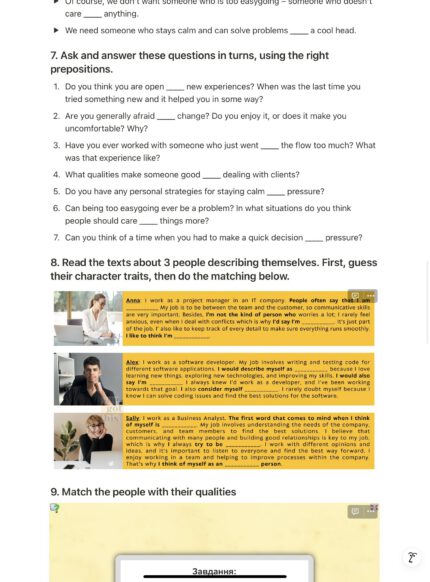
The 5 Personality Traits
In this lesson, your students will:
- Learn and practice key personality adjectives through context and personalization.
- Listen to an HR manager discuss the Big Five model and identify key traits for workplace success.
- Complete controlled and guided tasks to build accuracy in vocabulary and preposition use.
- Practice describing themselves and others using real-life contexts and structured prompts.
- Compare, contrast, and reflect on different personality profiles in spoken interaction.
This lesson includes 15 interactive exercises that develop students’ listening comprehension skills in the context of workplace personality traits and hiring practices, and expand their lexical resource through a focus on descriptive adjectives and collocations used to talk about personality and behavior.
Vocabulary: determined, open-minded, etc
Additional resources: LearningApps, Wordwall, Quizlet

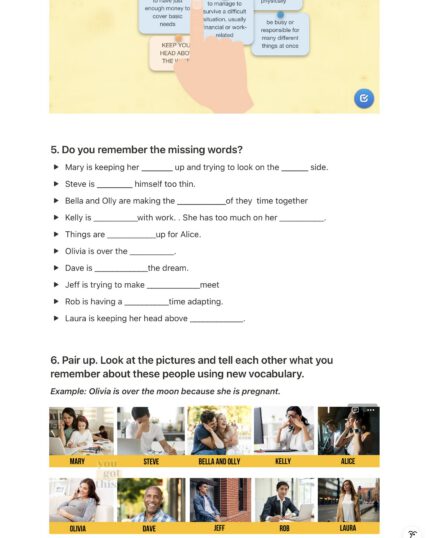
How Are You: Ups and Downs
In this lesson, your students will:
- Learn natural replies to both good and bad news
- Build emotional vocabulary: from “living the dream” to “spreading myself too thin”.
- Match and personalize idiomatic phrases.
- Role-play conversations about life’s ups and downs.
- Practice giving natural reactions and unsolicited advice.
- Fix common learner mistakes in phrasing and usage.
- Use interactive games, images, and prompts to help them personalize and internalize language.
This lesson includes 10+ interactive exercises to help students respond naturally to everyday check-in questions, build emotional vocabulary, gain confidence in giving updates and advice, and correct common mistakes with idiomatic language.
Vocabulary: things are looking up, living the dream, etc
Additional resources: LearningApps, Wordwall, Quizlet

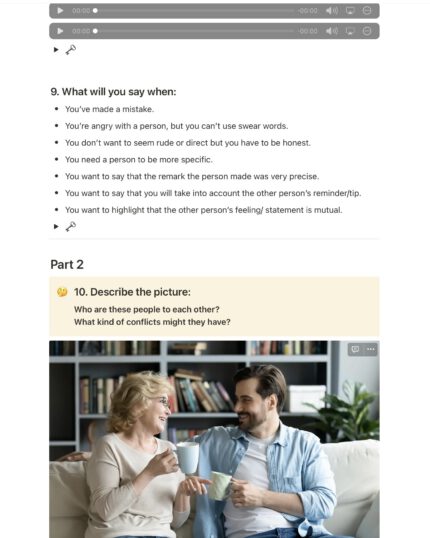
Quick Responses 2
In this lesson, your students will:
- Learn quick reaction phrases through fun, relatable dialogs.
- Practice in real-time with games, stories, and partner tasks.
- Notice certain pronunciation challenges.
- Personalize and use the phrases in realistic speaking challenges.
- Reflect, debate, and make new expressions stick naturally.
This lesson includes up to 20 interactive exercises to introduce and practice natural conversational responses in English so that students can react quickly and appropriately in informal situations.
Vocabulary: putting it lightly, give a break, duly noted, etc
Additional resources: LearningApps, Wordwall, Quizlet

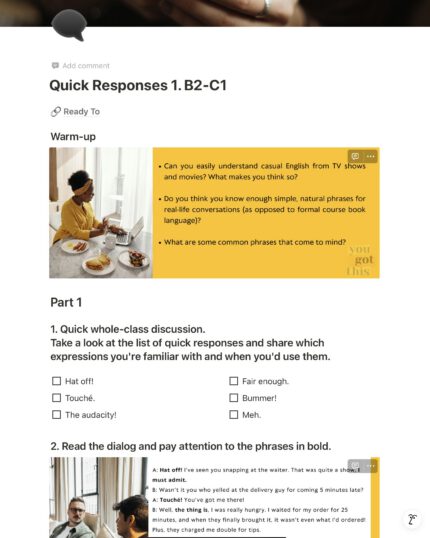
Quick Responses 1
In this lesson, your students will:
- Discover natural reaction phrases through real-life dialogues.
- Rephrase and personalize expressions to build confidence and retention.
- Practice reacting to fun, awkward, or surprising situations in pairs or groups.
- Act out conversations and take on quick-response speaking challenges.
- Reinforce key phrases with interactive games and pronunciation tasks.
- Reflect on personal experiences and apply new language in realistic contexts.
This lesson includes up to 20 interactive exercises to introduce and practice natural conversational responses in English so that students can react quickly and appropriately in informal situations.
Vocabulary: fair enough, audacity, that reminds me, etc
Additional resources: LearningApps, Wordwall, Quizlet

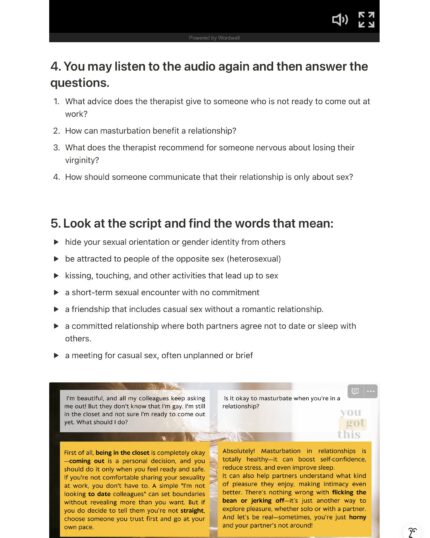
Bed Talk
This lesson covers essential making love vocab — fun, natural, and straight from movies, books, and real conversations.
In this lesson, your students will:
- Predict common issues raised with sex therapists to activate prior knowledge.
- Listen to real advice from a therapist and order the questions.
- Answer detailed comprehension questions.
- Learn euphemistic and slang vocabulary for discussing sexuality, identity, and intimacy.
- Discuss social and personal perspectives on identity disclosure, casual sex, and boundaries in modern relationships.
- Practice using the new vocabulary through matching, memory tasks, and dialog reconstruction.
- Reflect on personal attitudes and cultural norms through opinion-based speaking tasks.
This lesson contains 12 interactive exercises aimed at developing learners’ ability to understand and discuss common intimacy and relationship issues using natural, informal English vocabulary, including slang, euphemisms, and real-life expressions.
Vocabulary: friends with benefits, foreplay, booty call, etc
Additional resources: LearningApps, Wordwall