
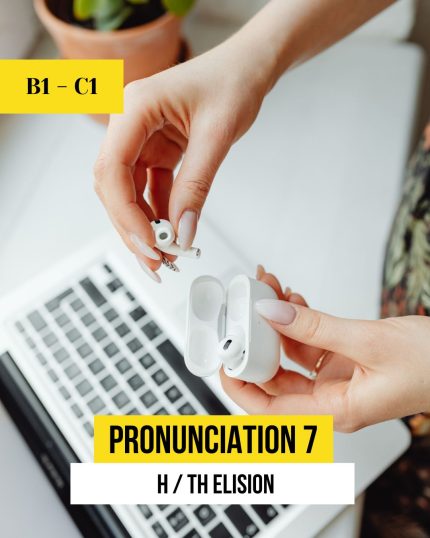
Pronunciation 7. H / TH Elision
In this lesson, your students will:
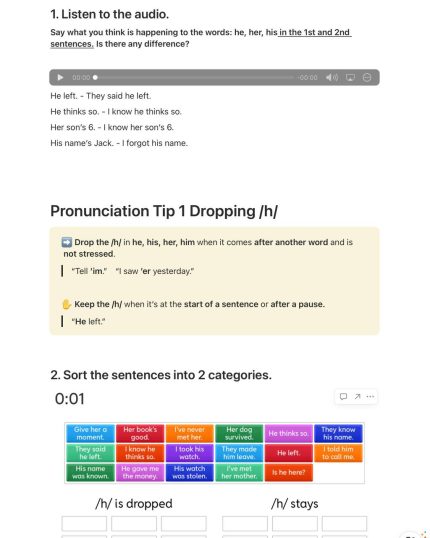
- Discover how native speakers drop sounds like /h/ and /ð/ in fast, connected speech.
- Notice when and why these sounds disappear through short listening clips and focused tasks.
- Train their ears and polish their pronunciation to catch these reductions through repetition drills and substitution dialogues.
- Put it into practice in a realistic context where they actually use the dropped sounds.
- Start recognizing these patterns in movies/shows, songs, and learn to sound more fluent themselves.
This lesson contains 15+ exercises that raise learners’ awareness of and ability to produce /h/ and /ð/ elision in connected speech, improving their listening comprehension and spoken fluency.

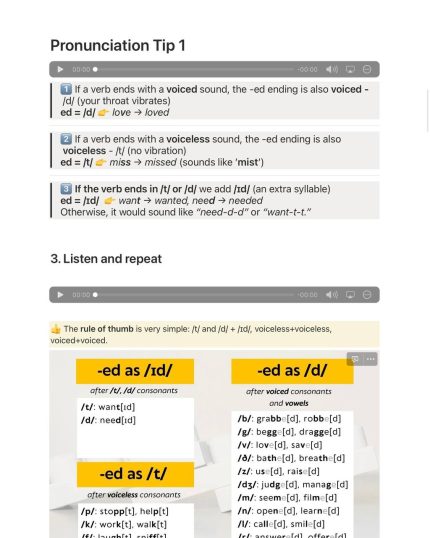
Pronunciation 6. Elision in ‘-ed’ endings
In this lesson, your students will:
- Activate the use and pronunciation of past forms in speaking.
- Test themselves by spotting and trying to correct pronunciation mistakes in past tense verbs.
- Use guided discovery tasks with hints to explore the pronunciations rules.
- Sort and match verbs into -ed ending patterns and practice the endings through listening and repetition.
- Use interactive drills and games to solidify the rules.
- Do semi-free practice tasks to gain more automaticity.
- Notice how native speakers often drop the endings in consonant clusters.
- Compare “clear” vs. “connected” speech versions of past forms.
- Retell a text and speak about their own past activities with attention to -ed endings and natural elision.
This lesson contains up to 20 exercises that develop students’ ability to recognize and produce regular past tense -ed endings accurately and to raise awareness of elision in connected speech (dropping /t/ or /d/ in clusters), so that their pronunciation sounds clearer, smoother, and more natural in fast English.
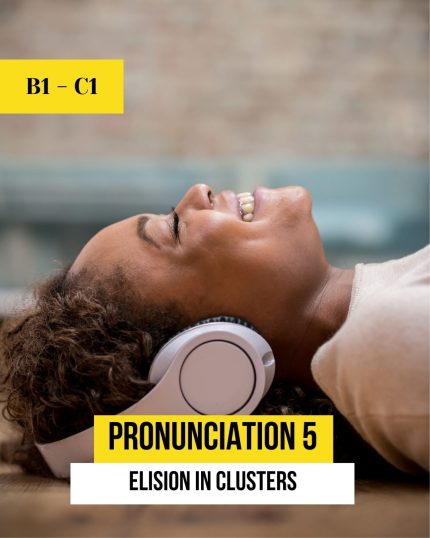
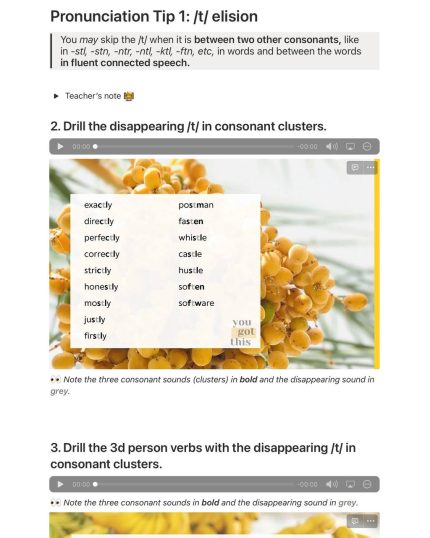
Pronunciation 5. Elision in clusters
In this lesson, your students will:
- Notice when /t/ and /d/ commonly drop in consonant clusters.
- Practice controlled drills of words and word combinations with elision.
- Spot and sort elision patterns in lists and Wordwall tasks.
- Improve listening discrimination through short dictations and “write what you hear” decoding.
- Paraphrase and produce high-frequency chunks with natural elision.
- Apply elision in timed speaking challenges and personalized prompts.
- Self-monitor pronunciation using keys that highlight potential vs. optional elision.
- Take home a ready-made audio drill for reinforcement.
- Realize the importance of noticing in accent acquisition
This lesson contains up to 15 interactive exercises that develop learners’ perception and production of /t/ and /d/ elision in connected speech—both within consonant clusters and across word boundaries—so that students can recognize these reduced forms in authentic listening and apply them accurately and confidently in their own speech.

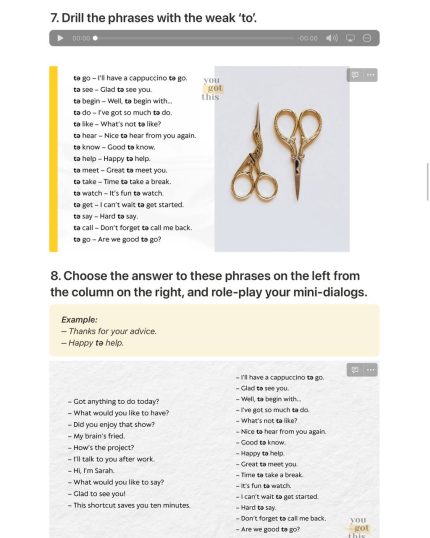
Pronunciation 4. Reduction
In this lesson, your students will:
- Discover the difference between careful and fast connected speech.
- Identify content words and function words in sentences.
- Learn and practice the weak and strong forms of certain prepositions and articles.
- Listen for reduced function words in authentic speech extracts.
- Drill sentences with reduction patterns.
- Roleplay short dialogues using weak forms naturally.
- Discuss personal questions while applying reductions.
- Complete a project task using an authentic speech extract.
- Practice and record themselves to receive feedback.
This lesson contains up to 20 interactive exercises that raise learners’ awareness of weak forms in connected American English speech and give them practice in recognizing, producing, and using these reductions in meaningful contexts, so that their spoken English sounds more natural, fluent, and easy to understand.
Features: Reduction of Function Words in Connected Speech
Additional resources: Wordwall, LearningApps

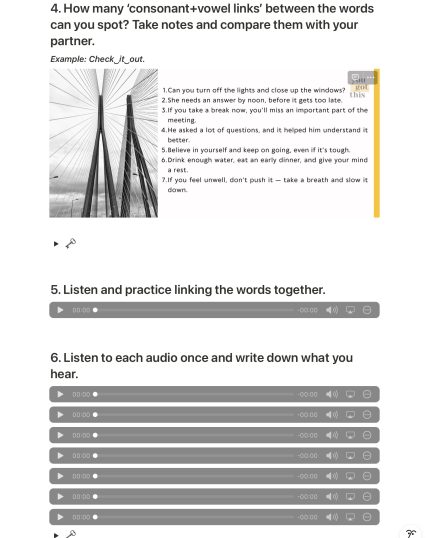
Pronunciation 3. Catenation.
In this lesson, your students will:
- Try themselves at decoding tricky pairs of phrases
- Notice and identify linking in phrases, sentences, and texts.
- Practice the “great and terrible” Flap T sound
- Reduce “and” naturally for flow and speed.
- Break down fast speech and imitate authentic rhythm and tone.
- Complete quizzes for better noticing skills
- Reinforce the features naturally through songs.
This lesson contains up to 20 interactive exercises that raise awareness of how native speakers connect words in real-life speech, identify and understand catenation, and improve listening skills and decoding ability through audio tasks and guided analysis.
Features: Catenation, Flap t, weak ‘and’ in Connected Speech
Additional resources: Wordwall

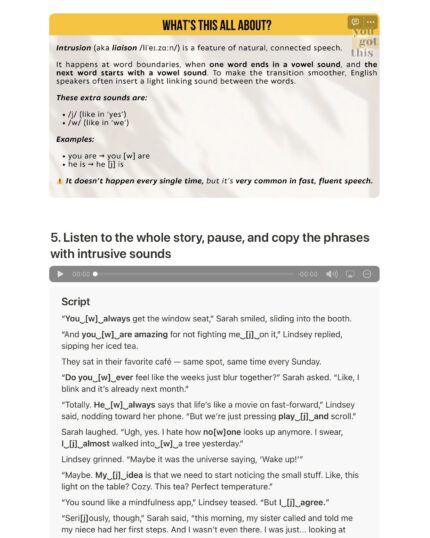
Pronunciation 2. Intrusion
In this lesson, your students will:
- Explore the topic of intrusion in connected speech
- Focus on audio decoding
- Learn to identify and detect intrusion through targeted listening activities
- Engage in various practice exercises
- Work with audio drills to polish pronunciation and listening accuracy
- Integrate the new material into speaking by discussing carefully designed conversation questions
This lesson contains 15 exercises to ensure maximum practice and build both awareness and confidence in real-life speech.
Features: intrusive /j/ and /w/ sounds in Connected Speech
Additional resources: Wordwall
Pronunciation 1. Assimilation
In this lesson your students will:
- Have a good laugh in the warm-up section
- Tune their ears with audio dictation
- Decode “strange” spellings to reveal natural pronunciation patterns
- Practice tricky words with tr- and dr-
- Sort and categorize words by sound patterns in interactive tasks
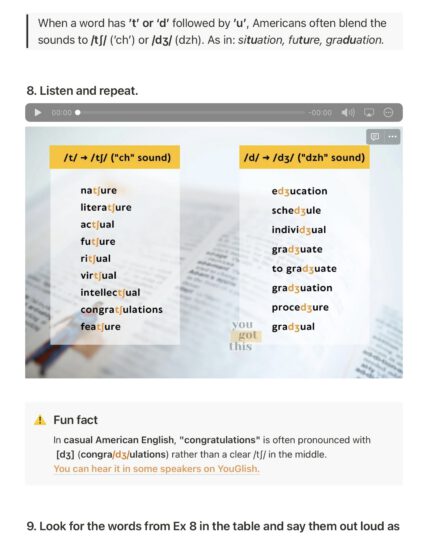
- Act out mini-dialogues with blended phrases like don’t you → don/tʃu/
- Read a mysterious story while focusing on pronunciation in context
- Take on a homework challenge to spot real-world pronunciation
This lesson contains 12 interactive exercises that raise awareness of features of connected speech in American English and help improve the ability to recognize and produce these features in context.
Skills: American Pronunciation
Features: tr-, dr-, -tu-, /tʃ/, /dʒ/ in Connected Speech
Additional resources: Wordwall, LearningApps