

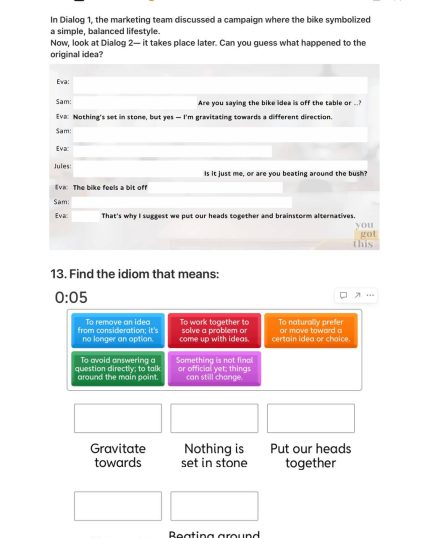
Did I get you right?
In this lesson, your students will:
-
- Brainstorm and sort phrases people use when they don’t understand something.
- Read and analyze a marketing team dialogue packed with natural clarification expressions.
- Check comprehension through multiple tasks — matching, sorting, and vocabulary review.
- Do a gap-fill activity to test recall of target phrases.
- Correct common learner mistakes in the target expressions.
- Transform sentences using target phrases to express the same ideas naturally.
- Play a Taboo-style speaking game: explain simple processes while partners ask clarification questions.
- Test retention by completing a table with all the lesson expressions.
- Continue in Part 2 with a new dialogue introducing idioms*.*
- Do listening tasks — filling in missing idioms and expressions while identifying meaning and tone.
- Practice word stress with verbs like gravitate, simplify, elaborate.
- Complete dialogues using new clarification phrases.
- Use speaking cards and agree/disagree prompts to apply idioms in discussion.
This lesson includes 23 exercises that develop students’ ability to ask for clarification, check understanding, and respond when confused in professional and everyday contexts, using natural conversational phrases and idioms.

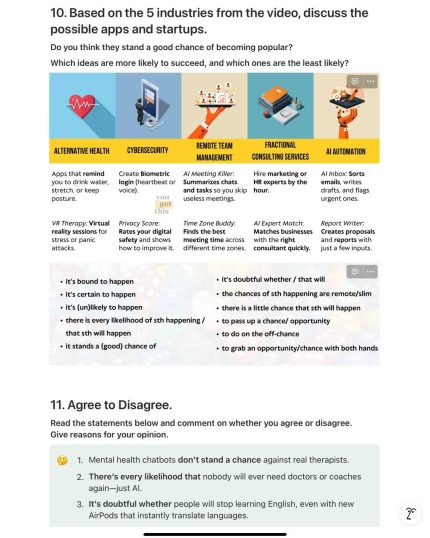
Startups. Chance and Probability
In this lesson, your students will:
-
- Read and retell startup dialogues using new probability expressions.
- Sort and unscramble chance-related phrases for accuracy and fluency.
- Make sentence transformations using target collocations in context.
- Watch a short authentic video and discuss trends in future business opportunities.
- Debate success vs. failure of unusual startup ideas
- Practice speaking about their own projects.
- Play a guessing game on real-life startup successes and failures.
- Reflect on their own chances and goals using the lesson’s vocabulary.
Vocabulary: on the off-chance, bound to happen, etc.
Additional resources: WordWall, LearningApps, Quizlet
This lesson includes 15 exercises that develop students’ ability to understand and accurately use a range of probability and chance expressions in spoken interaction through the engaging context of startup ideas.

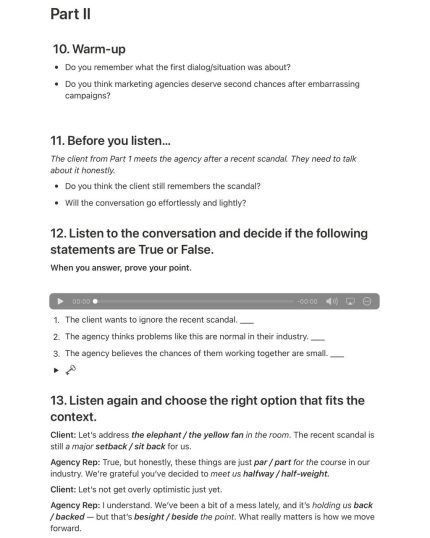
Business Idioms 2. Talking about problems
In this lesson, your students will:
- Reflect on their own experiences with problems at work
- Read and analyze a business dialogue, identifying how speakers express their views
- Explore idioms with guided comprehension questions
- Practice substituting idioms in a dialogue
- Roleplay workplace problem scenarios and decide which strategies would be effective or ineffective
- Listen to an authentic-style business dialogue and check comprehension
- Do controlled matching, sentence completion, and gapped paraphrasing activities
- Personalize idioms by finishing open-ended prompts
- Work in groups to prepare and present a short pitch
This lesson includes 20 exercises that help learners understand and use a range of business idioms for describing problems, risks, and solutions in workplace contexts in order to communicate more naturally and effectively about challenges and strategies in professional settings.
Vocabulary: sweep under the rug, turn things around, at stake, etc.
Additional resources: WordWall, LearningApps, Quizlet

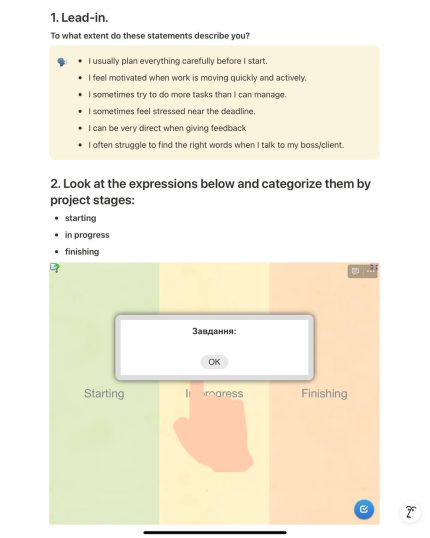
Business Idioms 1. Marketing & Project Stages
In this lesson, your students will:
– explore business idioms with their meanings and contexts
– reflect on project scenarios and their life cycle
– categorize expressions by project stages
– test comprehension through listening and guided exercises
– paraphrase business sentences using the new idioms
– play speaking games to reinforce fluency
– identify tricky client types and how to manage them
– analyze and retell a dialogue through guided discovery and prompts
– complete revision tasks and personalize the idioms
This lesson includes up to 20 exercises that develop learners’ ability to understand and use business idioms and expressions related to project work fluently and appropriately in spoken communication.
Level: B1, B2
Vocabulary: kick off, wiggle room, in full swing, etc.
Additional resources: WordWall, LearningApps, Quizlet

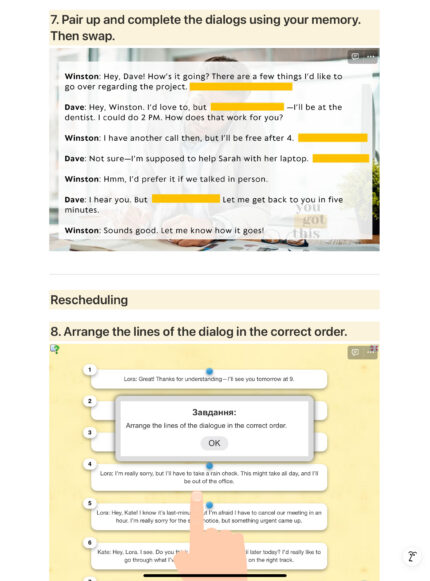
Scheduling Meetings
In this lesson, your students will:
- Examine the use of “-ish” in everyday speech.
- Match and complete realistic meeting dialogues, practicing how to schedule or rearrange calls.
- Rephrase common expressions used in business settings and casual conversations.
- Practice the pronunciation of key rescheduling phrases for natural, automatic use in conversation.
- Engage in functional dialogues about arranging and adjusting meetings using provided frameworks and visuals.
This lesson contains 15 interactive exercises and helps develop students’ functional language for scheduling and rescheduling events, raise awareness of nuanced time expressions, and encourage spoken fluency and pronunciation practice through drilling, rephrasing, and role-play.
Vocabulary: the -ish suffix, last-minute, I can’t make it 1 p.m., etc
Additional resources: WordWall, LearningApps, Quizlet

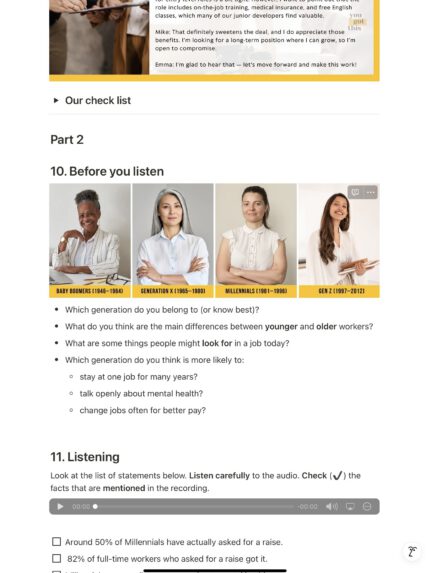
Negotiating Salary
In this lesson, your students will:
- Explore different attitudes to asking for a raise through real-life examples.
- Learn, practice, and memorize key phrases for salary negotiation and compromise.
- Compare workplace values across generations.
- Develop confidence in expressing expectations and discussing money tactfully.
- Use guided practice to build negotiation dialogs and give thoughtful advice.
This lesson includes 15 exercises that work together to enable students to use polite and confident language for negotiating salaries and benefits in job-related conversations.
Functional language: it’s not what I had in mind, I’m open to compromise, etc.
Vocabulary: meet you halfway, contribute, etc.
Additional resources: WordWall, LearningApps, Quizlet
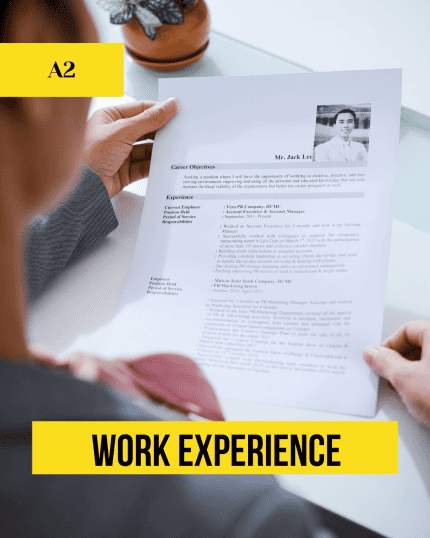
Work Experience
In this lesson, your students will:
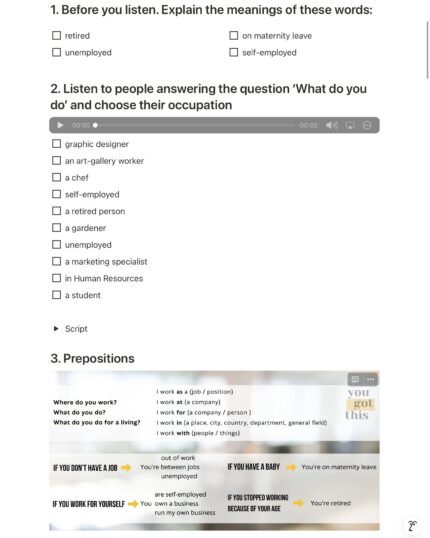
- Discuss job-related vocabulary and clarify the difference between “What do you do?” and “What are you doing?”
- Listen to people talk about their work and identify occupations and work situations.
- Practice using correct prepositions with work-related verbs.
- Describe professions using structured language and real-life context.
- Learn to rephrase and upgrade job-related expressions using more natural vocabulary.
- Match job phrases with definitions and collocations to boost retention.
- Practice real-life phrases related to job hunting and work experience
- Share personal stories and reflect on what matters most in a job
- Answer open-ended discussion questions about values, motivation, and dream jobs.
This lesson contains up to 20 interactive exercises that develop students’ ability to discuss jobs and employment using appropriate vocabulary and grammar and provide controlled and freer speaking practice on job-related topics.
Vocabulary: on-the-job training, hand-on experience, etc
Grammar: Prepositions with work
Additional resources: Wordwall, Quizlet

Job Interview
In this lesson, your students will:
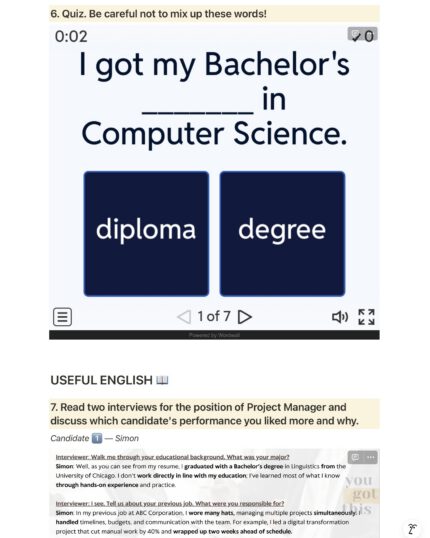
- Learn key vocabulary and phrases used in job interviews and practiсe using them naturally.
- Watch a humorous video interview and listen to how typical interview questions are handled.
- Read and compare candidate profiles and say who’s more likely to be hired and why.
- Work with phrases to describe personal qualities, identify strengths and weaknesses, and react appropriately.
- Reflect on interview etiquette—what to say, what to avoid, and how to make a good impression.
- Practiсe interviewing and being interviewed in pairs, using real-life questions and natural English.
This is a two-part lesson that includes up to 20 exercises that develop students’ confidence and fluency in understanding and responding to common job interview questions using appropriate language, tone, and vocabulary.
Vocabulary: graduated with a degree, tackle challenges, hands-on experience, quick on the uptake, etc
Additional resources: WordWall, Quizlet