

Hustle Culture
In this lesson, your students will:
- Read three short personal stories focusing on vocabulary about routines, stress, and slow living.
- Notice Present Simple and Present Continuous in the texts, discuss the rules, and practice using the corresponding time markers.
- Discuss personalization questions, reflecting on work habits, boundaries, guilt around rest, and work–life balance.
- Expand the topic with burnout, balance, deadlines, switching off, and multitasking vocabulary.
- Listen to a podcast, brainstorm and discuss small everyday techniques to train the brain to relax.
This lesson includes up to 20 exercises that give students the language and confidence to talk about their lifestyle, stress levels, routines, and attempts to slow down using Present Simple/Continuous and key vocabulary related to hustle culture and relaxation.

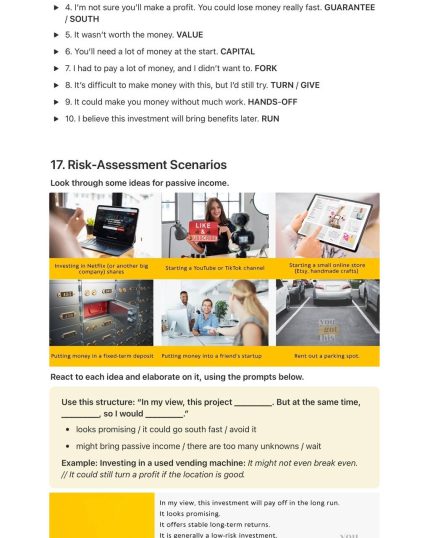
Money 2. Passive income
In this lesson, your students will:
- Build core money vocabulary through prediction, detailed listening, and retelling.
- Expand and personalize vocabulary through context.
- Develop functional language through real stories, noticing language, guided discovery.
- Use the language creatively in dilemmas, debates, and opinion tasks.
This lesson includes 20+ exercises that help students talk comfortably about passive income, understand its pros and cons, and use useful money vocabulary in real-life conversations.

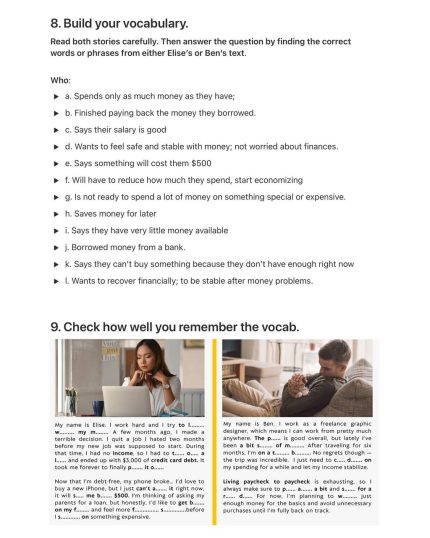
Money 1. Saving and Spending
In this lesson, your students will:
- Cover the basics of borrowing and banking, and practice basic money expressions.
- Reflect on money-related statements and discuss personal preferences and habits.
- Build and personalize vocabulary through context.
- Solve mini-dilemmas about money, ending with a revision game.
This lesson includes 15+ exercises that introduce and practice key vocabulary related to personal finance (saving, spending, borrowing, budgeting) and develop students’ ability to discuss money confidently and naturally.

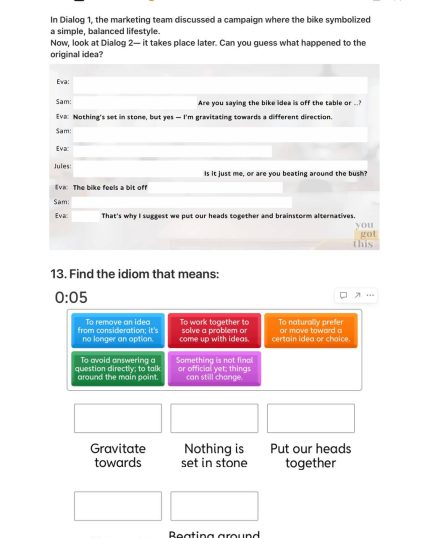
Did I get you right?
In this lesson, your students will:
-
- Brainstorm and sort phrases people use when they don’t understand something.
- Read and analyze a marketing team dialogue packed with natural clarification expressions.
- Check comprehension through multiple tasks — matching, sorting, and vocabulary review.
- Do a gap-fill activity to test recall of target phrases.
- Correct common learner mistakes in the target expressions.
- Transform sentences using target phrases to express the same ideas naturally.
- Play a Taboo-style speaking game: explain simple processes while partners ask clarification questions.
- Test retention by completing a table with all the lesson expressions.
- Continue in Part 2 with a new dialogue introducing idioms*.*
- Do listening tasks — filling in missing idioms and expressions while identifying meaning and tone.
- Practice word stress with verbs like gravitate, simplify, elaborate.
- Complete dialogues using new clarification phrases.
- Use speaking cards and agree/disagree prompts to apply idioms in discussion.
This lesson includes 23 exercises that develop students’ ability to ask for clarification, check understanding, and respond when confused in professional and everyday contexts, using natural conversational phrases and idioms.

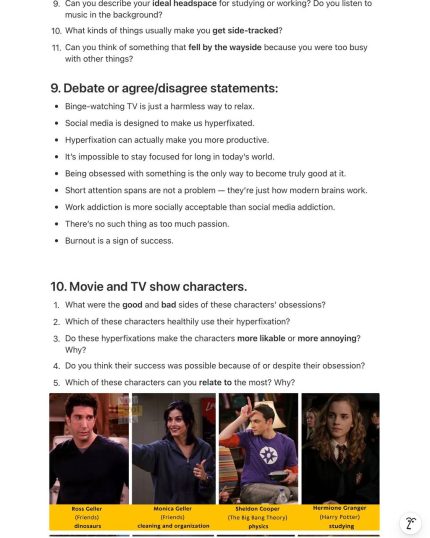
Hyperfixation and Attention
In this lesson, your students will:
- Share what they’re “hooked on” and reflect on their attention span situation.
- Discuss the concept of *hyperfixation* and predict its meaning.
- Focus on vocabulary through a short reading exercise.
- Explore three relatable stories and analyze people’s habits.
- Match quotes with characters, complete gap-fills, and do transformation tasks with target idioms.
- Discuss habits and distractions using idioms naturally in conversation.
- Reflect on statements about productivity, attention, and modern focus struggles.
- Connect the topic to pop culture, discussing movie/TV characters and their obsessions.
- Take the Attention Span Test and reflect on personal focus habits as homework.
This lesson includes 15 exercises that develop students’ ability to understand and discuss the concept of hyperfixation while learning natural, idiomatic expressions for talking about attention, distraction, and focus.

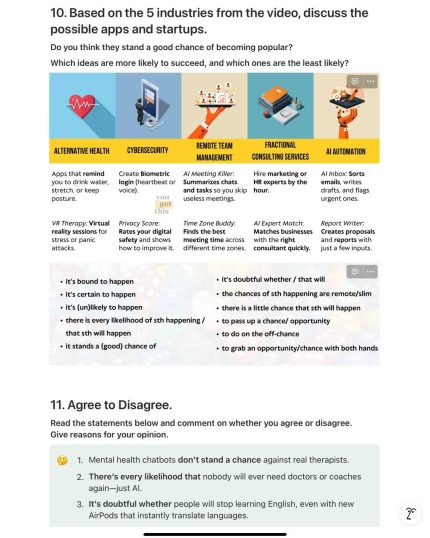
Startups. Chance and Probability
In this lesson, your students will:
-
- Read and retell startup dialogues using new probability expressions.
- Sort and unscramble chance-related phrases for accuracy and fluency.
- Make sentence transformations using target collocations in context.
- Watch a short authentic video and discuss trends in future business opportunities.
- Debate success vs. failure of unusual startup ideas
- Practice speaking about their own projects.
- Play a guessing game on real-life startup successes and failures.
- Reflect on their own chances and goals using the lesson’s vocabulary.
Vocabulary: on the off-chance, bound to happen, etc.
Additional resources: WordWall, LearningApps, Quizlet
This lesson includes 15 exercises that develop students’ ability to understand and accurately use a range of probability and chance expressions in spoken interaction through the engaging context of startup ideas.
Speaking: Overconsumption
In this speaking club, your students will:
-
- React to impactful photos and videos about consumerism and waste.
- Discuss ASMR “aesthetic” shopping/organization trends and their influence.
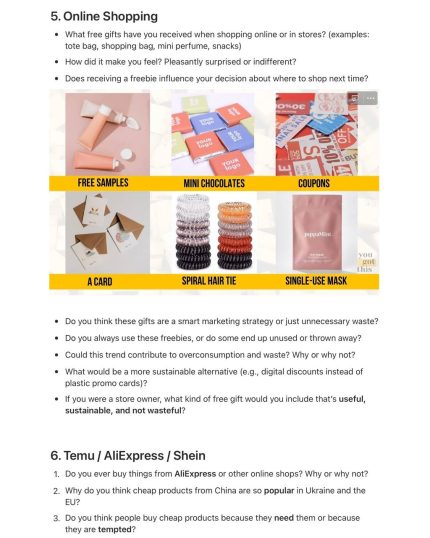
- Share experiences with online shopping, freebies, and cheap mass-market platforms.
- Analyze the impact of fast fashion and participate in mini-debates.
- Explore sustainable alternatives such as upcycling and eco-friendly habits.
- Compare shopping cultures in different countries and evaluate global practices.
- Identify their own “buyer type” and reflect on how advertising and social media affect them.
- Finish with reflecting on past shopping regrets and habits.
Where’s the line between smart consumption and wasteful habits? This lesson uses striking visuals, videos, and debates to get learners thinking about their own choices, while expanding their vocabulary and fluency around the theme of overconsumption.

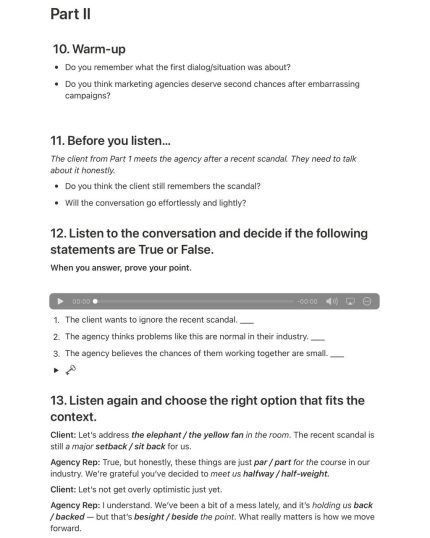
Business Idioms 2. Talking about problems
In this lesson, your students will:
- Reflect on their own experiences with problems at work
- Read and analyze a business dialogue, identifying how speakers express their views
- Explore idioms with guided comprehension questions
- Practice substituting idioms in a dialogue
- Roleplay workplace problem scenarios and decide which strategies would be effective or ineffective
- Listen to an authentic-style business dialogue and check comprehension
- Do controlled matching, sentence completion, and gapped paraphrasing activities
- Personalize idioms by finishing open-ended prompts
- Work in groups to prepare and present a short pitch
This lesson includes 20 exercises that help learners understand and use a range of business idioms for describing problems, risks, and solutions in workplace contexts in order to communicate more naturally and effectively about challenges and strategies in professional settings.
Vocabulary: sweep under the rug, turn things around, at stake, etc.
Additional resources: WordWall, LearningApps, Quizlet

Makeup
In this lesson, your students will:
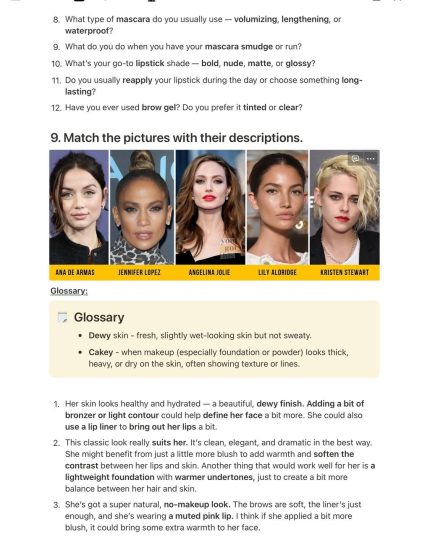
- Identify and label makeup areas on the face
- Learn the names of brushes and what they’re used for
- Describe makeup looks from photos and give suggestions
- Compare celebrity styles and discuss their impact
- Reflect on their own attitudes toward beauty and self-expression
- Watch and analyze videos featuring celebs
- Pick up tons of modern vocabulary they’ll actually want to use
Vocabulary: dab on some foundation, go full glam, etc.
Additional resources: WordWall, Quizlet
This lesson includes 15+ exercises that develop students’ speaking fluency and confidence when discussing makeup routines, products, and personal opinions about beauty using appropriate lexical chunks and collocations.

Business Idioms 1. Marketing & Project Stages
In this lesson, your students will:
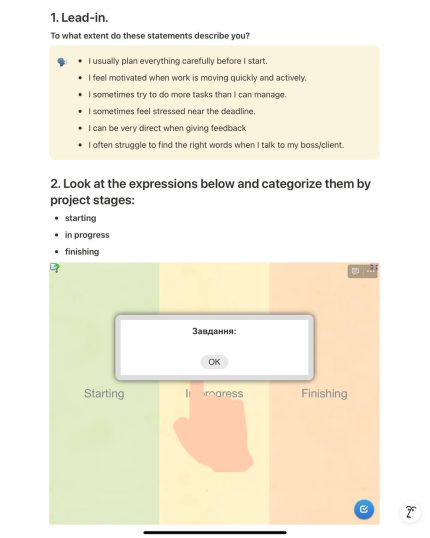
– explore business idioms with their meanings and contexts
– reflect on project scenarios and their life cycle
– categorize expressions by project stages
– test comprehension through listening and guided exercises
– paraphrase business sentences using the new idioms
– play speaking games to reinforce fluency
– identify tricky client types and how to manage them
– analyze and retell a dialogue through guided discovery and prompts
– complete revision tasks and personalize the idioms
This lesson includes up to 20 exercises that develop learners’ ability to understand and use business idioms and expressions related to project work fluently and appropriately in spoken communication.
Level: B1, B2
Vocabulary: kick off, wiggle room, in full swing, etc.
Additional resources: WordWall, LearningApps, Quizlet

Doctor’s Visit: Tests and Treatments
In this lesson, your students will:
- Reflect on doctor–patient communication styles
- Generate and listen to typical GP questions and practice writing and responding to them
- Explore key collocations with medical vocabulary and their meanings and real-life use
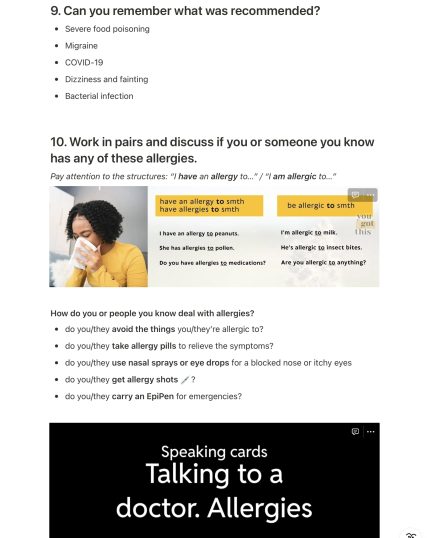
- Study the ways to talk about allergies
- Role-play a simple doctor visit using a model dialogue
- Practice phrases used at the pharmacy
- Compare healthcare systems and reflect on cultural differences
- Expand vocabulary on tests, medications, and health issues
This lesson includes 13 exercises that work together to expand students’ vocabulary related to symptoms, medical tests, and treatment, and build students’ confidence in using collocations and set phrases when discussing health issues.
Functional language: ”Are you in any pain?”, “Any history of illness in your family?”, etc.
Vocabulary: be allergic to, get an X-ray, etc.
Additional resources: WordWall, LearningApps, Quizlet
Symptoms, Injuries & First Aid
In this lesson, your students will:
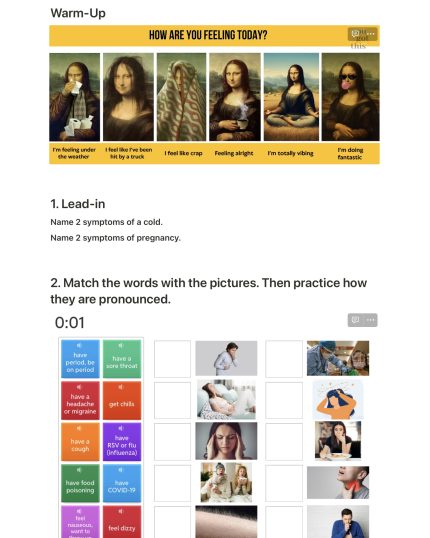
- Learn key illness-related words and make up commonly used health-related word combinations
- Listen to health complaints and guess the symptoms
- Compare flu, RSV, and COVID-19 symptoms by fact-checking them with a video
- Complete a natural conversation discussing sick leave
- Share personal habits and compare how they deal with common problems
- Take a side and argue whether certain health myths are true or false
- Find and learn useful expressions for symptoms, first aid, and emergencies
- Learn about basic first aid programs and test their instincts in emergency scenarios
This lesson includes up to 20 exercises that recognize, describe, and discuss common symptoms and health issues using relevant vocabulary.
Vocabulary: come down with a cold, get chills, perform CPR, etc.
Additional resources: WordWall, LearningApps, Quizlet