
Hustle Culture
In this lesson, your students will:
- Read three short personal stories focusing on vocabulary about routines, stress, and slow living.
- Notice Present Simple and Present Continuous in the texts, discuss the rules, and practice using the corresponding time markers.
- Discuss personalization questions, reflecting on work habits, boundaries, guilt around rest, and work–life balance.
- Expand the topic with burnout, balance, deadlines, switching off, and multitasking vocabulary.
- Listen to a podcast, brainstorm and discuss small everyday techniques to train the brain to relax.
This lesson includes up to 20 exercises that give students the language and confidence to talk about their lifestyle, stress levels, routines, and attempts to slow down using Present Simple/Continuous and key vocabulary related to hustle culture and relaxation.
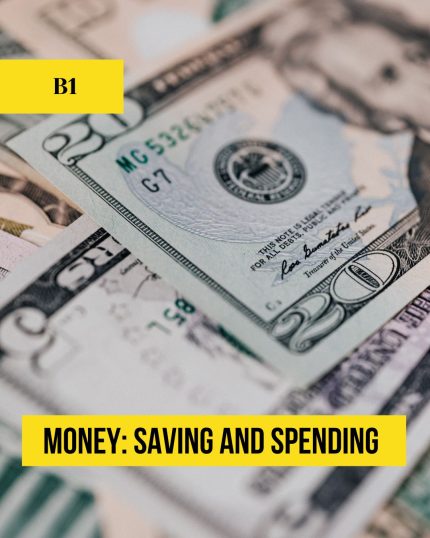
Money 1. Saving and Spending
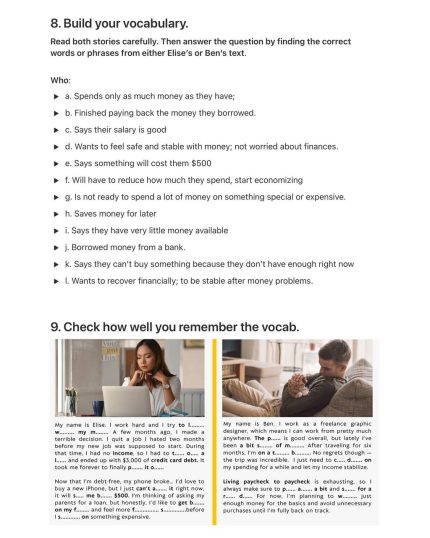
In this lesson, your students will:
- Cover the basics of borrowing and banking, and practice basic money expressions.
- Reflect on money-related statements and discuss personal preferences and habits.
- Build and personalize vocabulary through context.
- Solve mini-dilemmas about money, ending with a revision game.
This lesson includes 15+ exercises that introduce and practice key vocabulary related to personal finance (saving, spending, borrowing, budgeting) and develop students’ ability to discuss money confidently and naturally.

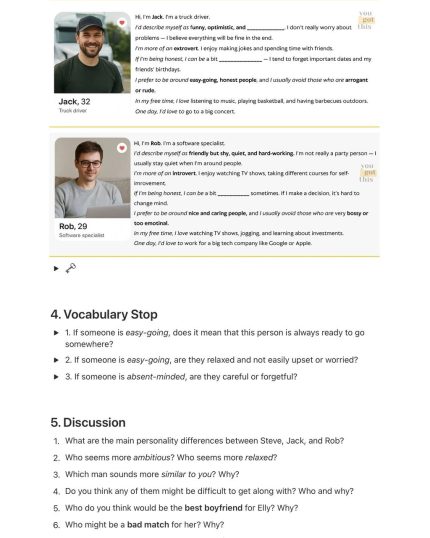
What are you like?
In this lesson, your students will:
- Reflect on their own personality and first impressions.
- Read short introductions of people and identify adjectives describing them.
- Learn and clarify meanings through guided vocabulary tasks.
- Practice using adjectives in meaningful sentences and short conversations.
- Predict which people may get along in life based on their characters.
- Listen for detail to identify traits in people described in short real-life monologues.
- Use personality adjectives fluently in free speaking and discussion tasks.
- Сhoose a well-known character and describe their personality.
- Do several rounds of revision for better memorization.
This lesson includes up to 20 exercises that develop students’ ability to describe personality and character naturally in spoken English using common adjectives and follow-up comments.

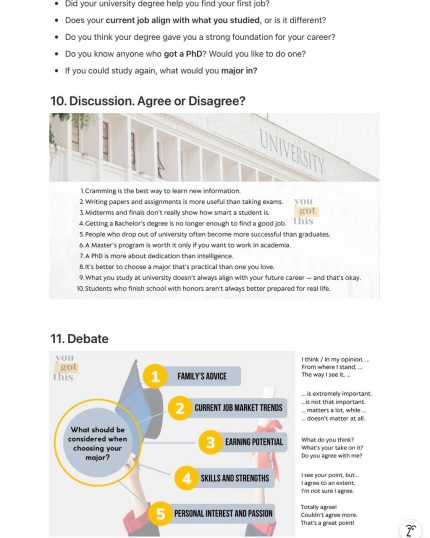
What’s your major? Education
In this lesson, your students will:
-
- Share what kind of students they were and how much they enjoyed studying.
- Watch a short video and practice saying their major.
- Fix common lexical mistakes about education and degrees.
- Listen to a monologue about university life and complete a gap-fill.
- Clarify and practice key academic phrases.
- Compare learning experiences using prompts and speaking cards.
- Debate on factors that play a role in choosing majors.
- Interview each other on their learning experiences, subjects, exams, etc.
- Compare education systems and the flexibility of choosing majors.
- Practice describing educational experience as part of a job interview.
This lesson contains up to 15 exercises that raise students’ awareness of and correct common errors when talking about education and degrees through clarification, controlled practice, and freer speaking activities using key academic vocabulary.
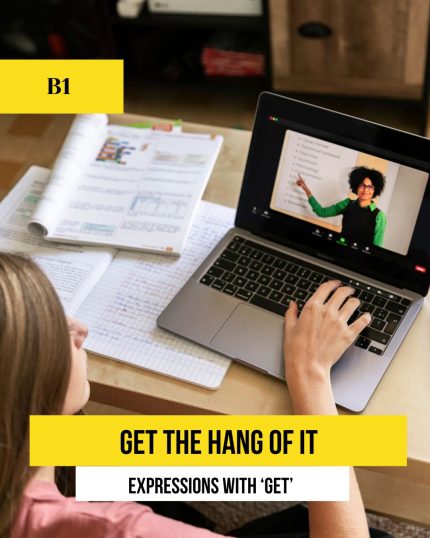
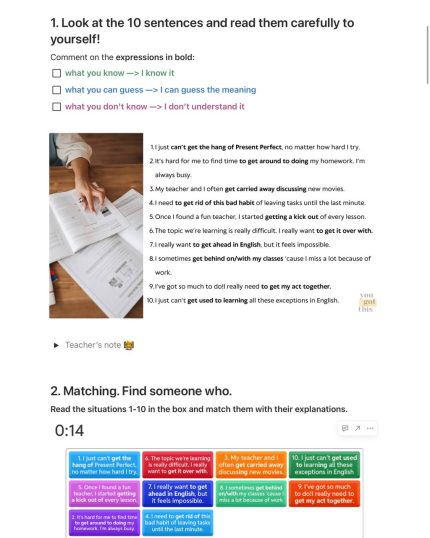
Get the hang of it. Expressions with ‘get’
In this lesson, your students will:
- explore and sort ‘get’ expressions by meaning and usage
- match real-life situations with the correct get collocations
- rephrase sentences using natural get expressions
- test themselves with interactive activities
- personalize language by sharing which expressions apply to their own lives
- practice extending ideas with follow-up phrases for fluency
- watch a short motivational video and connect it to ‘get” vocabulary
- role-play problem–solution tasks using ‘get’ expressions in context
- finish with reflection questions to consolidate the most useful phrases
This lesson contains up to 15 exercises that expand students’ vocabulary by introducing and practicing common multi-word expressions with get, and to provide opportunities for personalization and fluency practice through controlled, guided, and freer activities.
Vocabulary: get a kick out of, get the hang of, etc.
Additional resources: WordWall, LearningApps, Quizlet
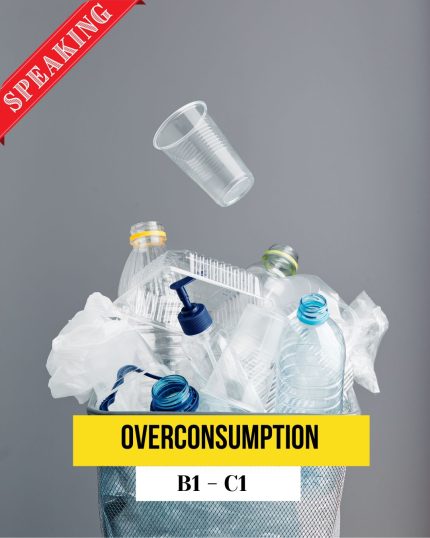
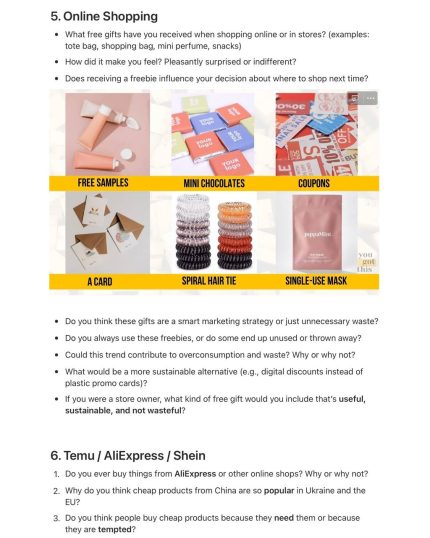
Speaking: Overconsumption
In this speaking club, your students will:
-
- React to impactful photos and videos about consumerism and waste.
- Discuss ASMR “aesthetic” shopping/organization trends and their influence.
- Share experiences with online shopping, freebies, and cheap mass-market platforms.
- Analyze the impact of fast fashion and participate in mini-debates.
- Explore sustainable alternatives such as upcycling and eco-friendly habits.
- Compare shopping cultures in different countries and evaluate global practices.
- Identify their own “buyer type” and reflect on how advertising and social media affect them.
- Finish with reflecting on past shopping regrets and habits.
Where’s the line between smart consumption and wasteful habits? This lesson uses striking visuals, videos, and debates to get learners thinking about their own choices, while expanding their vocabulary and fluency around the theme of overconsumption.
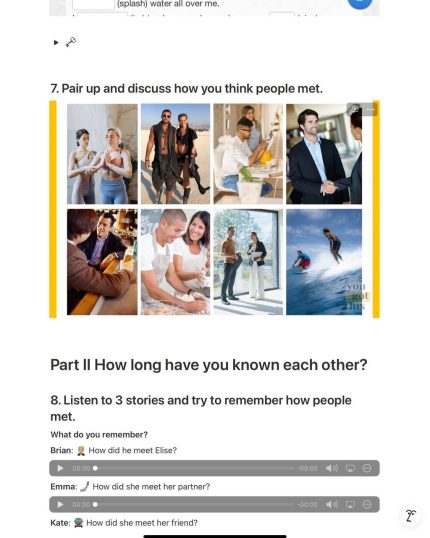
How we met. Past Simple vs Continuous. Present Perfect
In this lesson, your students will:
- reflect on important people in their lives and share impressions
- predict and listen to stories of how real couples met
- sort and analyze sentences to discover Past Simple vs. Past Continuous
- complete gap-fill exercises to practice both tenses in context
- drill and ask/answer short questions using substitution prompts
- explore Present Perfect with for and since through guided discovery
- play oral drill games with Q&A patterns
- write and personalize their own sentences with target structures
- use role cards to ask and answer about people they know
This lesson includes 15+ exercises to help students become better able to narrate past experiences using Past Simple and Past Continuous and talk about relationships using Present Perfect with for/since.
Grammar: Past Simple vs. Past Continuous. Present Perfect with for/since
Additional resources: WordWall, LearningApps, Quizlet
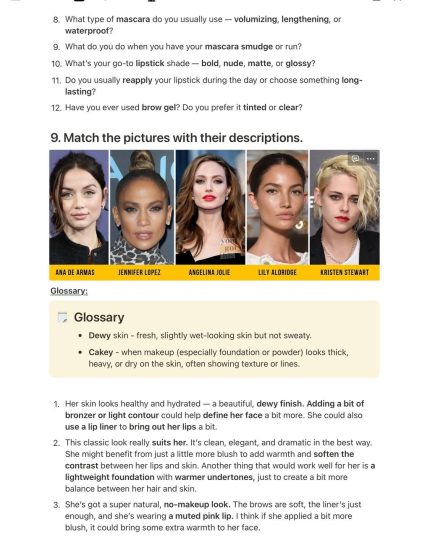
Makeup
In this lesson, your students will:
- Identify and label makeup areas on the face
- Learn the names of brushes and what they’re used for
- Describe makeup looks from photos and give suggestions
- Compare celebrity styles and discuss their impact
- Reflect on their own attitudes toward beauty and self-expression
- Watch and analyze videos featuring celebs
- Pick up tons of modern vocabulary they’ll actually want to use
Vocabulary: dab on some foundation, go full glam, etc.
Additional resources: WordWall, Quizlet
This lesson includes 15+ exercises that develop students’ speaking fluency and confidence when discussing makeup routines, products, and personal opinions about beauty using appropriate lexical chunks and collocations.
Business Idioms 1. Marketing & Project Stages
In this lesson, your students will:
– explore business idioms with their meanings and contexts
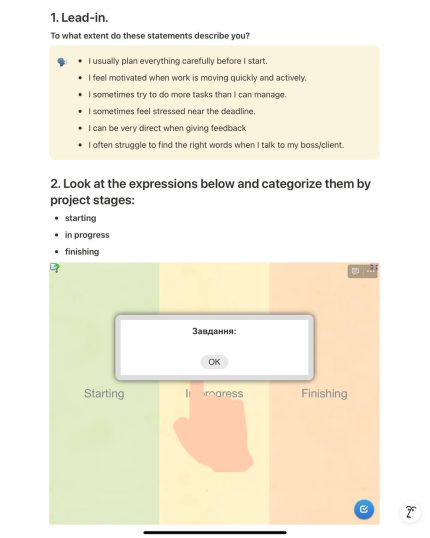
– reflect on project scenarios and their life cycle
– categorize expressions by project stages
– test comprehension through listening and guided exercises
– paraphrase business sentences using the new idioms
– play speaking games to reinforce fluency
– identify tricky client types and how to manage them
– analyze and retell a dialogue through guided discovery and prompts
– complete revision tasks and personalize the idioms
This lesson includes up to 20 exercises that develop learners’ ability to understand and use business idioms and expressions related to project work fluently and appropriately in spoken communication.
Level: B1, B2
Vocabulary: kick off, wiggle room, in full swing, etc.
Additional resources: WordWall, LearningApps, Quizlet
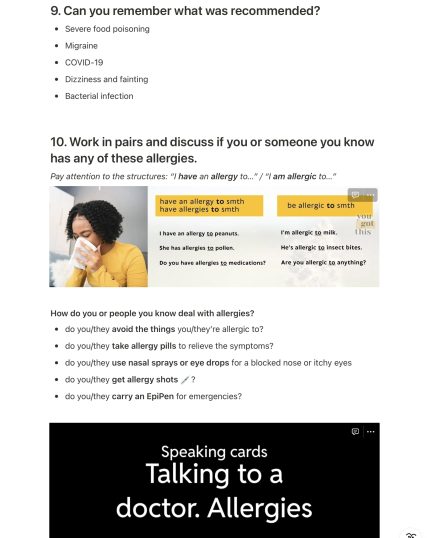
Doctor’s Visit: Tests and Treatments
In this lesson, your students will:
- Reflect on doctor–patient communication styles
- Generate and listen to typical GP questions and practice writing and responding to them
- Explore key collocations with medical vocabulary and their meanings and real-life use
- Study the ways to talk about allergies
- Role-play a simple doctor visit using a model dialogue
- Practice phrases used at the pharmacy
- Compare healthcare systems and reflect on cultural differences
- Expand vocabulary on tests, medications, and health issues
This lesson includes 13 exercises that work together to expand students’ vocabulary related to symptoms, medical tests, and treatment, and build students’ confidence in using collocations and set phrases when discussing health issues.
Functional language: ”Are you in any pain?”, “Any history of illness in your family?”, etc.
Vocabulary: be allergic to, get an X-ray, etc.
Additional resources: WordWall, LearningApps, Quizlet
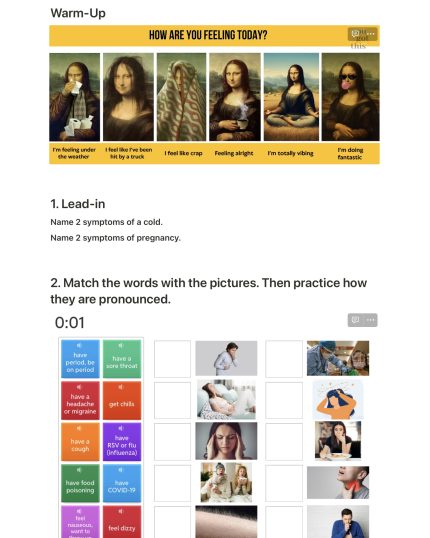
Symptoms, Injuries & First Aid
In this lesson, your students will:
- Learn key illness-related words and make up commonly used health-related word combinations
- Listen to health complaints and guess the symptoms
- Compare flu, RSV, and COVID-19 symptoms by fact-checking them with a video
- Complete a natural conversation discussing sick leave
- Share personal habits and compare how they deal with common problems
- Take a side and argue whether certain health myths are true or false
- Find and learn useful expressions for symptoms, first aid, and emergencies
- Learn about basic first aid programs and test their instincts in emergency scenarios
This lesson includes up to 20 exercises that recognize, describe, and discuss common symptoms and health issues using relevant vocabulary.
Vocabulary: come down with a cold, get chills, perform CPR, etc.
Additional resources: WordWall, LearningApps, Quizlet
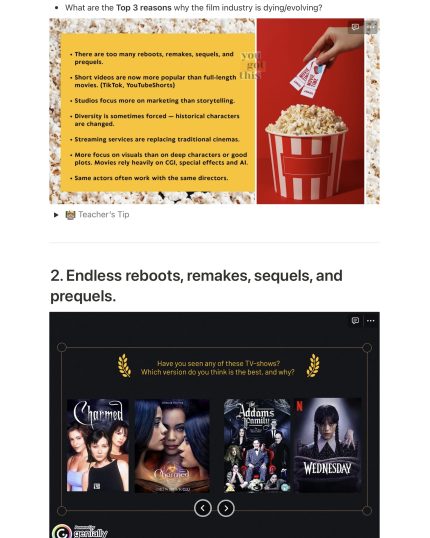
Speaking: Film Industry
In this speaking club, your students will:
- Dive into hot-button trends like TikTok, reboots, and CGI to debate whether the film industry is evolving or losing its spark
- Discuss how they feel about constant reboots, remakes, prequels and sequels.
- Debate the pros and cons of reboots, long vs short content, and streaming
- Discuss diversity and race-swapping in Hollywood and its cultural impact
- Analyze what makes an Oscar-worthy performance
Tired of the same old movie talk? This lesson dives deep into the real changes shaping today’s film industry — from TikTok to diversity debates and Oscar drama. Your students will explore what’s evolving, what’s collapsing, and what’s worth celebrating in modern cinema.