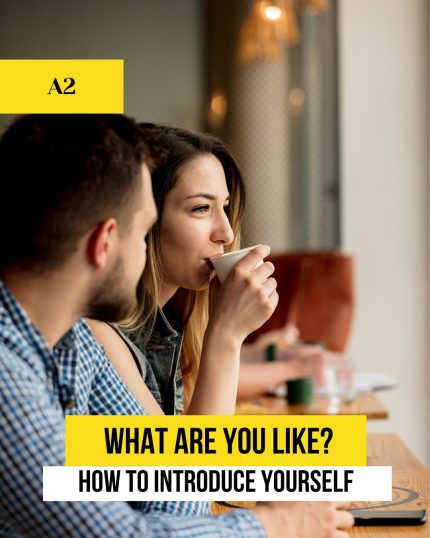
What are you like?
In this lesson, your students will:
- Reflect on their own personality and first impressions.
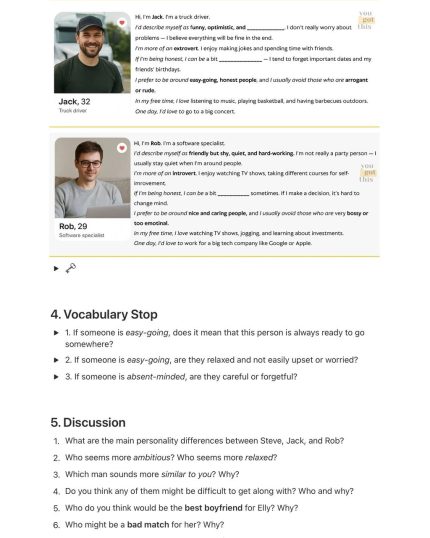
- Read short introductions of people and identify adjectives describing them.
- Learn and clarify meanings through guided vocabulary tasks.
- Practice using adjectives in meaningful sentences and short conversations.
- Predict which people may get along in life based on their characters.
- Listen for detail to identify traits in people described in short real-life monologues.
- Use personality adjectives fluently in free speaking and discussion tasks.
- Сhoose a well-known character and describe their personality.
- Do several rounds of revision for better memorization.
This lesson includes up to 20 exercises that develop students’ ability to describe personality and character naturally in spoken English using common adjectives and follow-up comments.
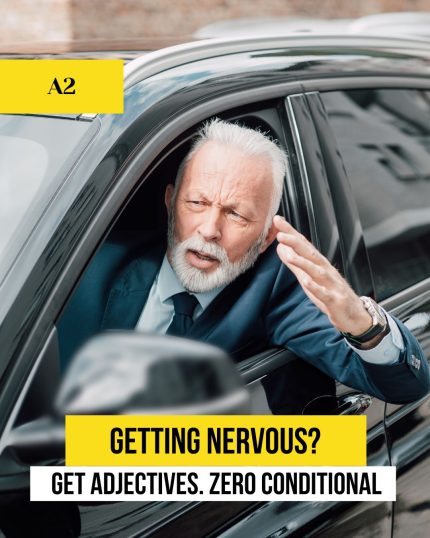
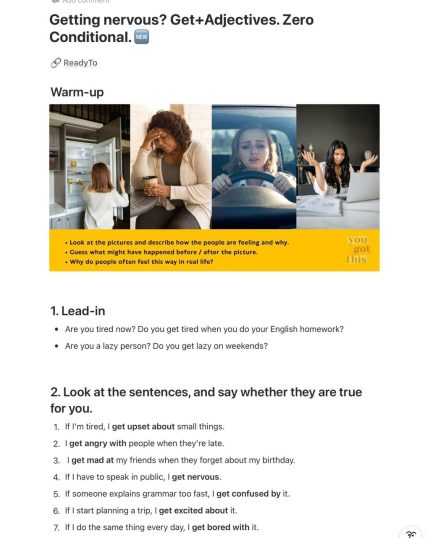
Getting nervous? Get+Adjectives. Zero Conditional.
In this lesson, your students will:
- Explore sentences with get + adjective and check which ones describe them.
- Review prepositions and the difference between if and when, touching on Zero Conditionals.
- Complete sentences with their own ideas and share with a partner.
- Learn to distinguish between states and changes with be + adjective and get + adjective.
- Sort examples, listen, fill in gaps, and create their own sentences.
- Drill mini dialogs with get + adjective.
- Describe feelings in everyday situations and discuss a text about “vacation fatigue.”
- Reflect on emotional reactions and discuss what makes people tired, excited, or stressed.
- Practice an audio drill with get + adjectives for pronunciation and fluency.
This lesson includes 15+ exercises that provide controlled and freer practice of be + adjective and get + adjective structures to describe states and changes of state in everyday contexts.

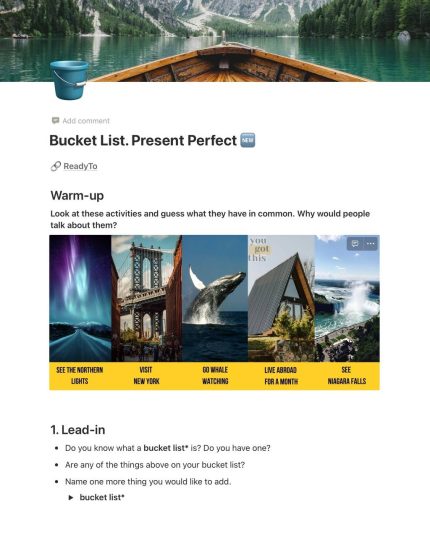
Bucket List. Present Perfect
In this lesson, your students will:
-
- Explore the idea of a bucket list and share their own dream experiences.
- Listen to and watch short clips about travel and life goals.
- Practice Present Perfect (ever/never) vs. Past Simple in personal contexts.
- Drill forms with already and yet through controlled and semi-controlled practice.
- Use superlatives + ever to talk about “the best/worst” life experiences.
- Reflect on their own achievements and future goals in meaningful conversations.
- Create their own bucket list challenge and present it to the group.
- Use ready-made audio-drill as homework practice.
This lesson includes up to 30 exercises that give learners confidence using the Present Perfect and Past Simple to talk about life experiences and bucket list goals, while making grammar practice meaningful, memorable, and personally relevant.
Grammar: Past Simple vs. Present Perfect / Present Perfect with ever/never, already/yet, superlative adjectives
Additional resources: Quizlet
How we met. Past Simple vs Continuous. Present Perfect
In this lesson, your students will:
- reflect on important people in their lives and share impressions
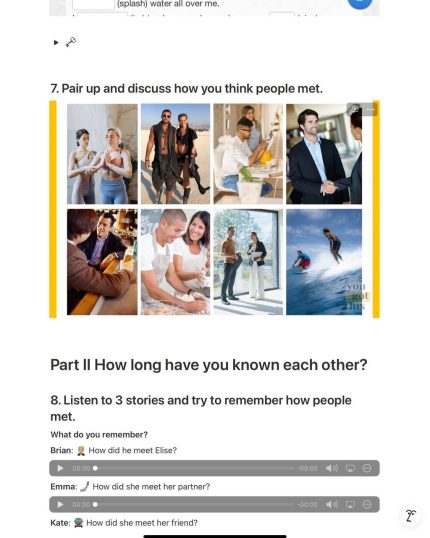
- predict and listen to stories of how real couples met
- sort and analyze sentences to discover Past Simple vs. Past Continuous
- complete gap-fill exercises to practice both tenses in context
- drill and ask/answer short questions using substitution prompts
- explore Present Perfect with for and since through guided discovery
- play oral drill games with Q&A patterns
- write and personalize their own sentences with target structures
- use role cards to ask and answer about people they know
This lesson includes 15+ exercises to help students become better able to narrate past experiences using Past Simple and Past Continuous and talk about relationships using Present Perfect with for/since.
Grammar: Past Simple vs. Past Continuous. Present Perfect with for/since
Additional resources: WordWall, LearningApps, Quizlet

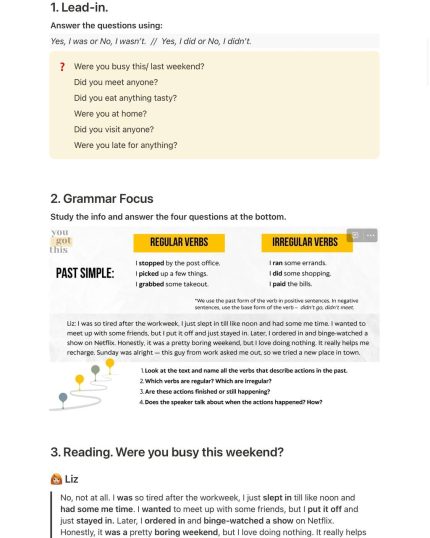
Busy Weekend. Past Simple
In this lesson, your students will:
- choose and compare weekend activities they consider fun or boring
- answer and ask simple Past Simple questions about their weekend
- read short personal weekend stories
- drill collocations and their past forms
- paraphrase sentences using target collocations in Past Simple
- make and ask detailed follow-up questions about weekend activities
- discuss and reflect on their own preferences
- explore a list of high-energy and low-energy weekend activities
- practice prepositions of place through listening, sorting, and speaking tasks
This lesson includes 15+ exercises that develop learners’ ability to talk about past weekend activities using Past Simple forms, common collocations, and functional phrases for sharing and asking about personal experiences.
Grammar: Past Simple for states and actions, irregular verbs. Bonus: prepositions of place
Vocabulary: binge-watch a show, hit a bar, fill up the car, etc.
Additional resources: WordWall, Quizlet
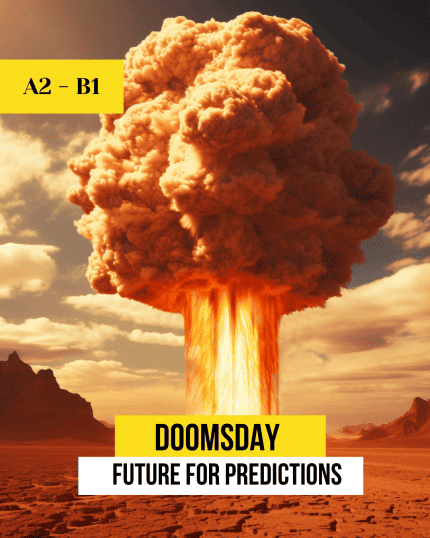
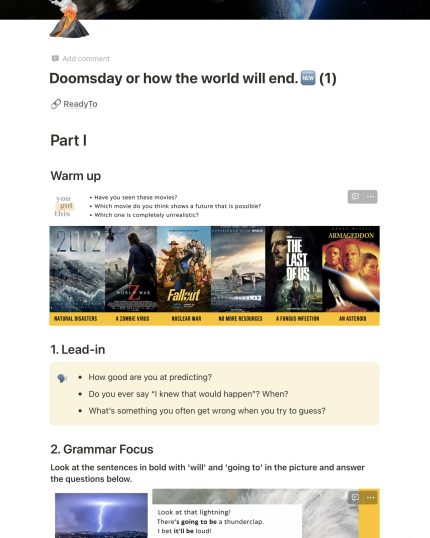
Doomsday. Future Tenses
In this lesson, your students will:
- Make future predictions based on visuals, context, and emotions
- Read wild doomsday theories and decide which one sounds the most real
- Share their opinions on future world events and personal life milestones
- Listen to authentic audio stories filled with tension and emotion, and make real-time predictions
- Rank survival items, giving reasons and predictions
This lesson includes up to 15 exercises that work together to clarify the difference between will and going to for predictions and evidence, build confidence using future forms in context, and spark imagination and meaningful conversation.
Grammar: ‘will’ and ‘going to’ for predictions
Additional resources: WordWall, LearningApps, Quizlet
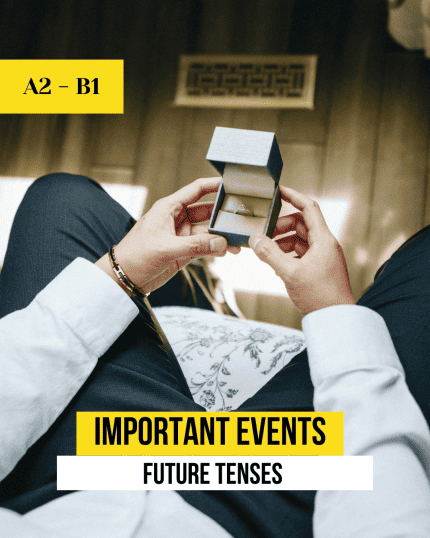
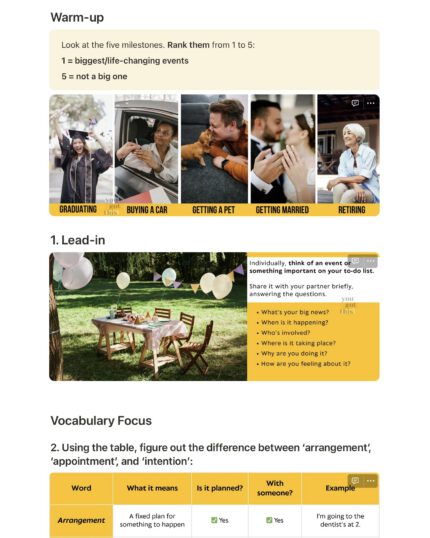
Important Events
In this lesson, your students will:
- Discover and compare how we talk about the future using ‘will’, ‘going to’, and Present Continuous
- Practice choosing the correct form through real-life examples and controlled exercises
- Personalize and discuss their own future plans, intentions, and decisions
- Engage in dialogues, reactions, and planning tasks to build fluency and natural conversation skills
- Reflect on milestones and life events using accurate grammar and vocabulary
This lesson includes 15 exercises that help students clearly distinguish between ‘will’, ‘going to’, and Present Continuous when talking about the future, and improve fluency and confidence in speaking about intentions, fixed plans, and spontaneous decisions using natural, spoken English.
Grammar: Future Forms (will, going to, Pres. Cont.)
Vocabulary: reacting to good news
Additional resources: WordWall, Quizlet, Learning Apps
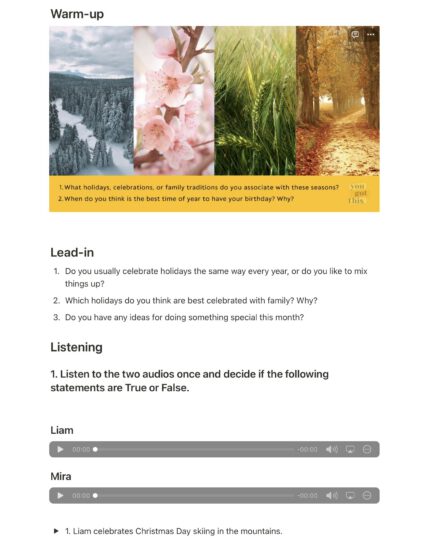
Holiday Celebrations
In this lesson, your students will:
- Practice listening for detail through stories about real holiday routines
- Review and confidently use prepositions of time (at, on, in) in meaningful contexts
- Learn to describe celebrations and personal traditions using natural phrases
- Explore and practice the structure “thinking of + -ing” for future plans
- Personalize grammar through storytelling, discussion, and real-life examples
- Build fluency through sentence correction, speaking drills, and engaging visuals
- Boost vocabulary and accuracy with interactive games and a fun grammar challenge
This lesson contains 12+ interactive exercises that develop students’ ability to accurately use prepositions of time (at, on, in) and the structure “thinking of + -ing” through the context of holidays and seasonal plans. It also provides practice in listening for gist and specific information and encourages spoken fluency through personalized discussions about holiday routines and plans.
Grammar: Prepositions of time / ‘thinking of’
Additional resources: Wordwall, Quizlet, LearningApps

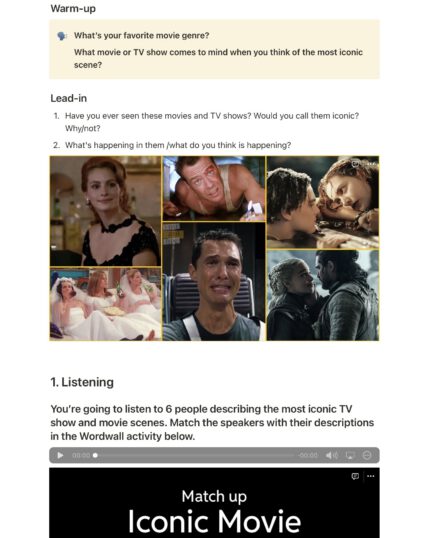
Iconic Movie Scenes
In this lesson, your students will:
- Explore and react to opinions about popular series using natural conversation.
- Practice and personalize vocabulary like grow on me, binge-watch, and not my thing.
- Compare Present Continuous for now vs around now in relatable contexts.
- Drill and use Present Continuous forms confidently in speaking.
- Describe real-time and current activities using rich, visual prompts.
- Reflect on their own viewing habits and practice fluency in discussions.
This lesson contains 15+ interactive exercises that provide clarification and controlled practice of the Present Continuous tense through the lens of iconic movie scenes. Students get the chance to speak about familiar and emotionally engaging films and series, using Present Continuous naturally alongside reaction language. They also review and activate a range of adjectives to describe emotional responses to what they watch.
Vocabulary: hilarious, gives me goosebumps, etc
Grammar: Present Continuous
Additional resources: Wordwall, Quizlet, LearningApps
Essential Apps
In this lesson, your students will:
- Read about how people use apps to improve their daily lives.
- Explore the phrases “in order to,” “so that,” and “in order for somebody to.”
- Practice with five grammar exercises to master these phrases.
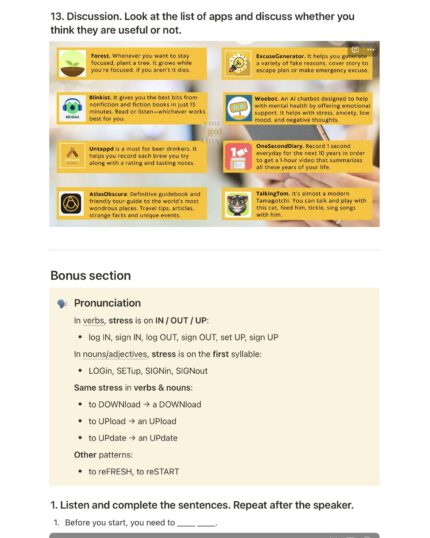
- Discuss the purpose of the most popular—and even the weirdest—apps!
- Enjoy the Bonus Section!
- Practice with the audio to perfect your pronunciation of words like: 💬 log in, 💬 comments, 💬 refresh.
This lesson contains up to 20 interactive exercises that help correctly use “in order to,” “so that,” and “in order for” to express purpose and develop fluency by discussing personal experiences with technology. As a bonus section: practicing pronunciation of phrasal verbs related to technology.
Grammar: clauses of purpose with in order to/for, so that
Additional resources: LearningApps, Wordwall, Quizlet
Work Experience
In this lesson, your students will:
- Discuss job-related vocabulary and clarify the difference between “What do you do?” and “What are you doing?”
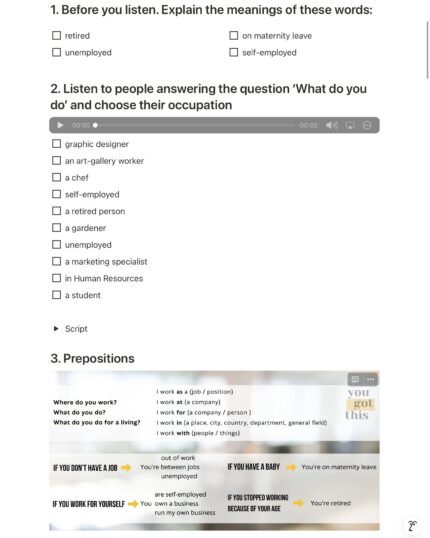
- Listen to people talk about their work and identify occupations and work situations.
- Practice using correct prepositions with work-related verbs.
- Describe professions using structured language and real-life context.
- Learn to rephrase and upgrade job-related expressions using more natural vocabulary.
- Match job phrases with definitions and collocations to boost retention.
- Practice real-life phrases related to job hunting and work experience
- Share personal stories and reflect on what matters most in a job
- Answer open-ended discussion questions about values, motivation, and dream jobs.
This lesson contains up to 20 interactive exercises that develop students’ ability to discuss jobs and employment using appropriate vocabulary and grammar and provide controlled and freer speaking practice on job-related topics.
Vocabulary: on-the-job training, hand-on experience, etc
Grammar: Prepositions with work
Additional resources: Wordwall, Quizlet
Seasonal Disorder
In this lesson, your students will:
- Explore what SAD is and how it affects people.
- Listen for symptoms in a psychologist’s talk and build confidence in listening.
- Retell and explain SAD using everyday vocabulary.
- Share personal experiences and give supportive advice.
- Read about relatable characters and reflect on their stories.
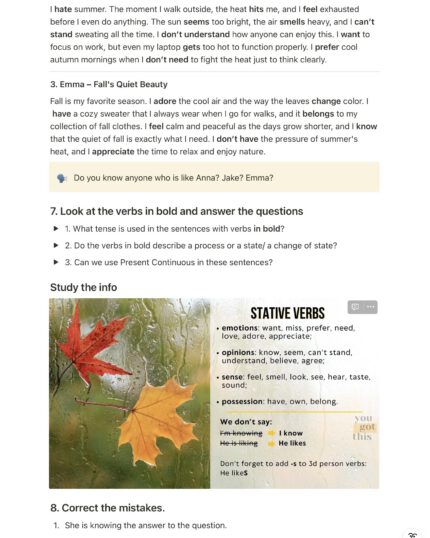
- Notice and practice stative verbs in context.
- Correct common grammar mistakes.
- Practice fluency through retelling and short dialogues.
- Personalize language through meaningful sentence completions.
This lesson includes up to 17 interactive exercises that ensure a balance of listening, speaking, grammar, and personal reflection in the context of seasonal changes and mood. It also highlights and analyzes the use of stative verbs in the Present Simple tense.
Grammar: stative verbs
Additional resources: LearningApps, Wordwall, Quizlet