

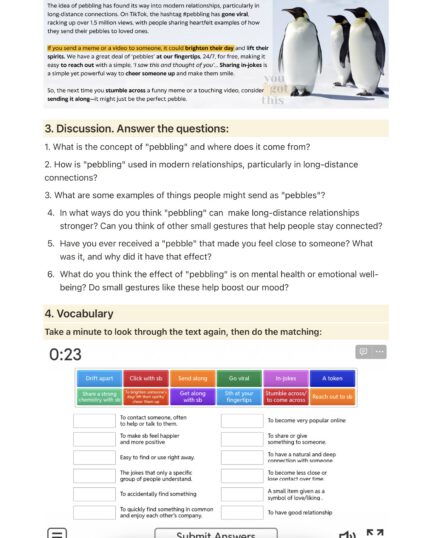
Pebbling
In this lesson your students will:
- Read a short, thought-provoking article about the new TikTok trend “Pebbling” and its impact on modern relationships.
- Explore key expressions related to relationships, and practice using them in context to build natural, conversational English skills.
- Practice the First Conditional with mini-dialogues and exercises in real-life contexts.
- Discuss Pebbling and its effect on long-term relationships.
- Use the First Conditional in meaningful conversations.
The lesson features 13 interactive exercises and a Quizlet set to provide your students with plenty of engaging practice across all skills.
Grammar: First Conditional
Vocabulary: get along with, have a strong chemistry, share in-jokes, etc.
Additional resources: Quizlet, Wordwall

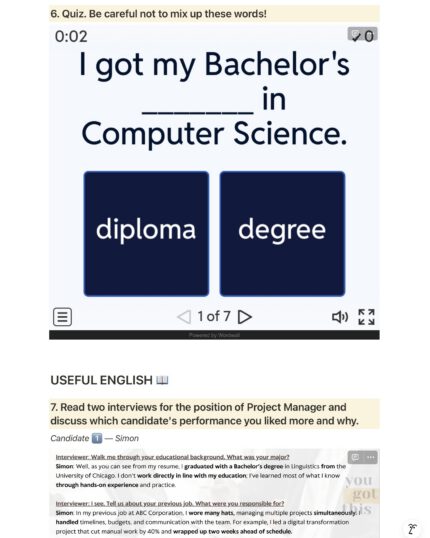
Job Interview
In this lesson, your students will:
- Learn key vocabulary and phrases used in job interviews and practiсe using them naturally.
- Watch a humorous video interview and listen to how typical interview questions are handled.
- Read and compare candidate profiles and say who’s more likely to be hired and why.
- Work with phrases to describe personal qualities, identify strengths and weaknesses, and react appropriately.
- Reflect on interview etiquette—what to say, what to avoid, and how to make a good impression.
- Practiсe interviewing and being interviewed in pairs, using real-life questions and natural English.
This is a two-part lesson that includes up to 20 exercises that develop students’ confidence and fluency in understanding and responding to common job interview questions using appropriate language, tone, and vocabulary.
Vocabulary: graduated with a degree, tackle challenges, hands-on experience, quick on the uptake, etc
Additional resources: WordWall, Quizlet

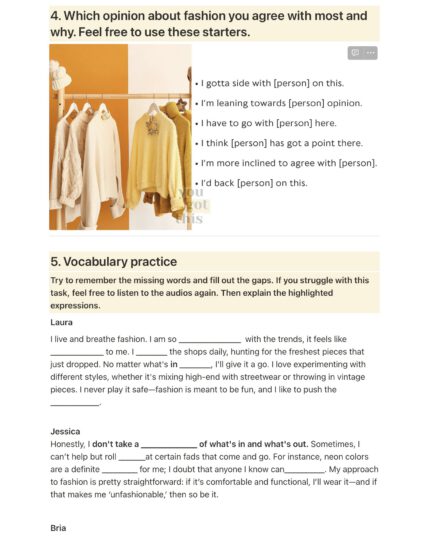
All things Fashion
In this lesson, your students will:
- Learn and practice authentic fashion-related vocabulary and idiomatic expressions.
- Listen to three speakers with different attitudes toward fashion and match them to style types.
- Work on gap-fill and paraphrasing tasks to reinforce vocabulary in context.
- Share their views on fashion, what’s in and what’s out, and react to controversial fashion “rules”.
- Compare trends from different decades, discuss fashion dos and don’ts, and correct typical lexical errors.
- Reflect on sustainable fashion, explore related terms, and discuss their own shopping habits.
This is a three-part lesson that includes up to 15 exercises that develop students’ ability to understand and use contemporary vocabulary and expressions related to fashion trends and personal style, through listening, discussion, and lexical practice.
Vocabulary: au fait with, a no-go, lean towards, scour, sustainable, etc
Additional resource: WordWall, Quizlet

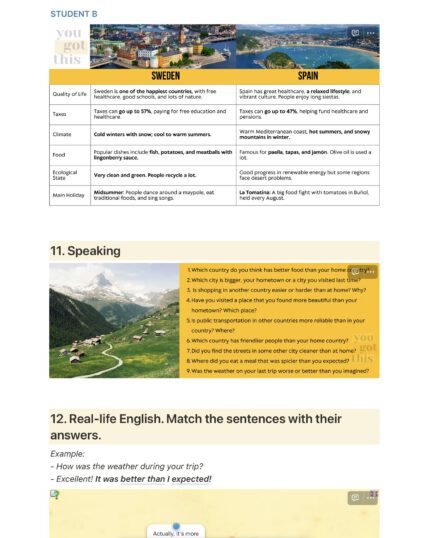
A Better Place
In this lesson, your students will:
- Learn and practice comparative adjectives to describe places, experiences, and opinions.
- Listen to a fun and realistic conversation and compare different countries.
- Work with vocabulary for travel, food, climate, and lifestyle, and use it in context.
- Test their grammar with fun tasks and spot common mistakes with comparatives.
- Speak about real and imagined trips, compare countries, and share personal opinions using new expressions.
- Use natural spoken English to react, compare, and describe everyday experiences.
This lesson includes up to 15 exercises that work together to engage students in meaningful practice of comparative adjectives in the context of describing countries, experiences, and preferences.
Grammar: Comparatives
Vocabulary: more delicious than you think, harder than I thought, etc
Additional resources: WordWall, LearningApps

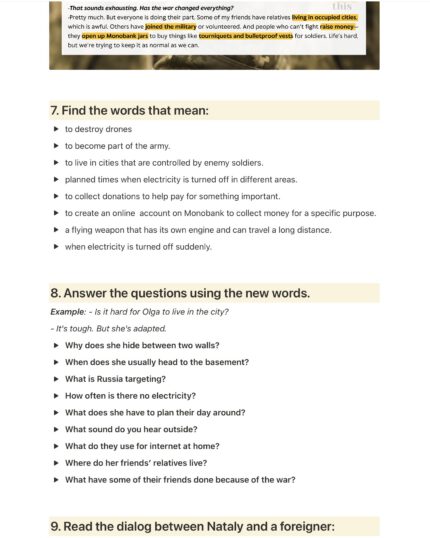
War in Ukraine
In this lesson, your students will:
- Learn and practice useful words and phrases related to war, safety, and everyday life during conflict.
- Match new vocabulary to meanings, complete sentences, and use the phrases in context.
- Read real-life-style dialogues and understand what people are going through.
- Use the new vocabulary to answer questions, share thoughts, and describe personal experiences.
- Explore common myths about Ukraine and explain why they aren’t true.
- Build confidence using English to tell stories, express opinions, and raise awareness.
This lesson includes up to 20 exercises that develop students’ ability to understand and use vocabulary related to war through the context of first-person dialogues and real-world experiences.
Vocabulary: shoot down, curfew, rolling blackouts, etc
Additional resources: WordWall, Quizlet

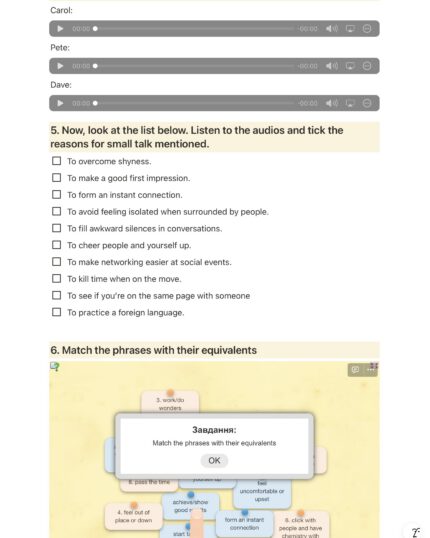
The Art of Small Talk
In this lesson, your students will:
- Listen to different opinions about the purpose of small talk.
- Learn and practice useful vocabulary for everyday conversations.
- Discuss taboo and inappropriate topics in different cultures.
- Transform back-handed compliments into kind and genuine ones.
- Practice making natural small talk on a variety of topics.
- Watch and comment on a video that brings the topic to life.
This lesson contains 18 interactive exercises to help students develop confidence and fluency in making small talk in American English, enabling them to engage in natural, friendly conversations in different social settings.
Vocabulary: strike up a conversation, from the word go, timid, etc.
Additional resources: LearningApps, Wordwall, Quizlet

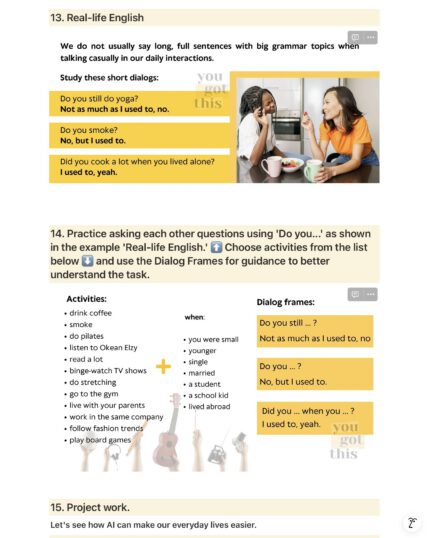
Before and After AI
In this lesson, your students will:
- Share their experiences with AI and discuss their opinions about ChatGPT.
- Build reading comprehension skills by checking true/false statements and reading real-life stories about the use of AI.
- Practice pronunciation of useful vocabulary from the texts.
- Expand their vocabulary by matching phrases with meanings, completing sentences, and using them in personal contexts.
- Focus on the grammar structure ‘used to’ through context-based discovery, form clarification, and structured practice.
- Use real-life dialogue frames to practice asking and answering questions naturally about daily habits and routines.
- Complete a practical project where they use ChatGPT to solve real-life problems.
- Reflect on how AI can change their everyday routines by comparing how they handled things before and after using AI.
This lesson includes up to 20 exercises, all centered around a single theme, working together in a sequence that provides clarification and practice of the structure “used to” in the context of discussing changes in lifestyle, habits, and the use of AI tools.
Grammar: Used to
Vocabulary: a game-changer, flip through, live up to smb’s expectations, etc
Additional resources: talking to ChatGPT and Hume AI, Wordwall, LearningApps, Quizlet

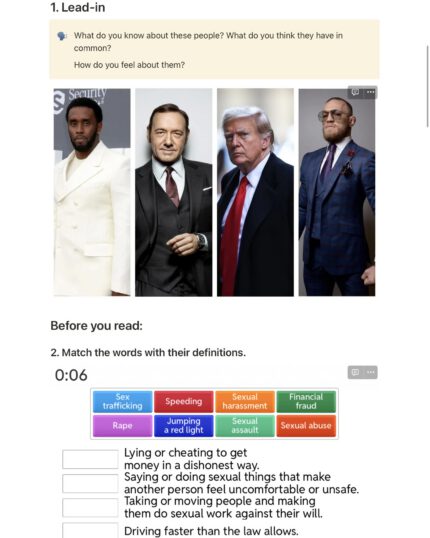
Speaking: Infamous Criminals
Here’s what’s waiting for you and your students:
- Explore infamous public figures and the crimes they’ve committed
- Learn the difference between terms like sexual assault, abuse, and harassment (in simple language!)
- Debate over the concept of cancel culture and different types of punishment
- React to a controversial statement by Stanford professor Robert Sapolsky about our brains and free will
- Discuss whether Scandinavian-style comfortable prisons are a step forward or just plain wrong
This is one of our favorite speaking club lessons — and trust us, your students won’t want to stop talking! It includes just a touch of vocabulary work to help your students talk about crime with confidence. Talking about Sean “Diddy” Combs is long overdue, so let’s dive in!

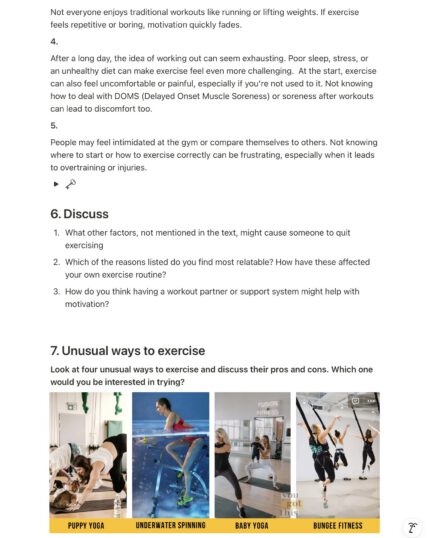
Speaking: Fitness
In this speaking club your students will:
- Discuss the purpose and benefits of different types of exercise
- Explore pros and cons of popular fitness activities
- Read a short article on why people often give up on working out
- Discover unusual types of fitness and motivation to choose one that suits them best
- Watch a fun short video and debunk common fitness myths
- Reflect on the connection between physical and mental health
Why do people quit exercising—and how can you stay on track? This Speaking Club addresses common fitness challenges and helps students with practical solutions. Reflect on your fitness habits, share experiences, and use interactive exercises to make lasting habits. Ready to get active? Try the lesson now!
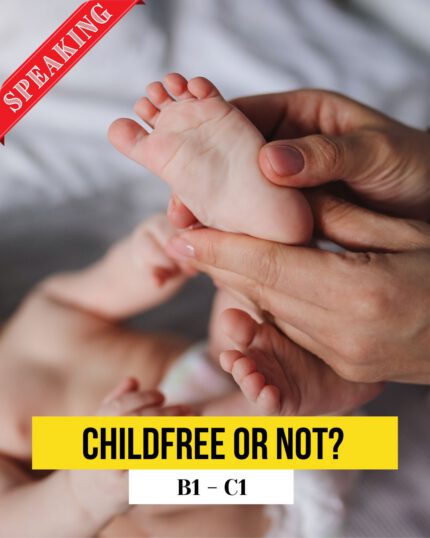
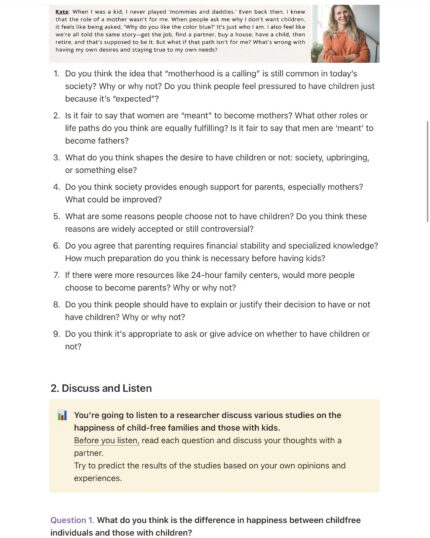
Speaking: Childfree
In this speaking club your students will:
- Read women’s opinions on the topic of being childfree.
- Discuss societal pressure.
- Take a peek into various studies on the effect of children on happiness.
- Watch a funny but brutally honest video about the difficulties of motherhood.
- Debate over statements.
- Discuss the evolution of parenting and how it might change in the future.
- Resolve parenting and childfree dilemmas.
This Speaking Club sparks debates on the choice of having children or staying childfree. With interactive exercises, games, and speaking cards, students explore different perspectives, dilemmas, and surprising facts. Ready to get the conversation flowing? Grab the lesson now!
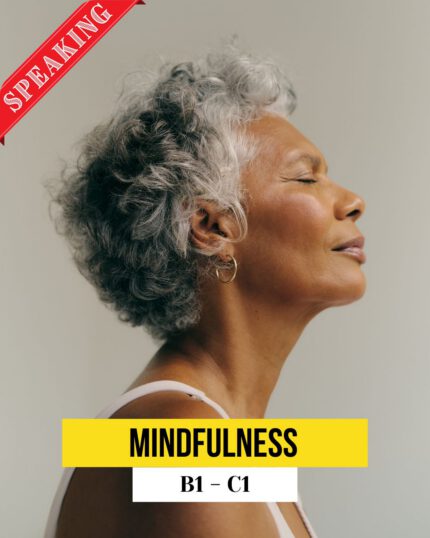
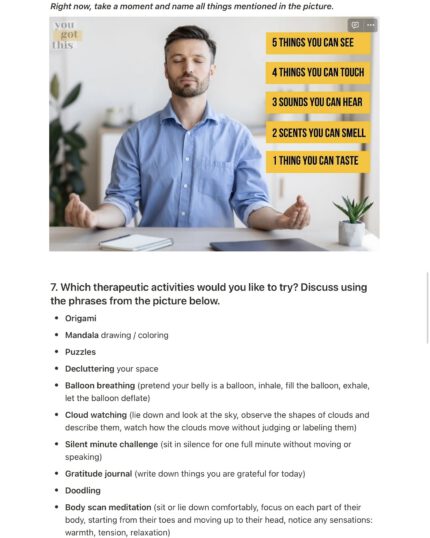
Speaking: Mindfulness
In this speaking club your students will:
- Break down the concept of mindfulness and its benefits.
- Discuss what makes us pause and enjoy the moment.
- Read real stories about what children can teach us about happiness.
- Brainstorm ways to become more mindful.
- Explore 5 top tips for practicing mindfulness.
- Play a mindfulness game and talk about therapeutic activities.
- Discuss relaxation techniques, meditations, and retreats while using useful expressions.
Meet your next must-have Speaking Club! This lesson explores modern distractions, appreciating small moments, and learning from children. With engaging activities and speaking cards, students will practice mindfulness and fluency while discovering personal insights. Ready to dive in? Grab the lesson now!

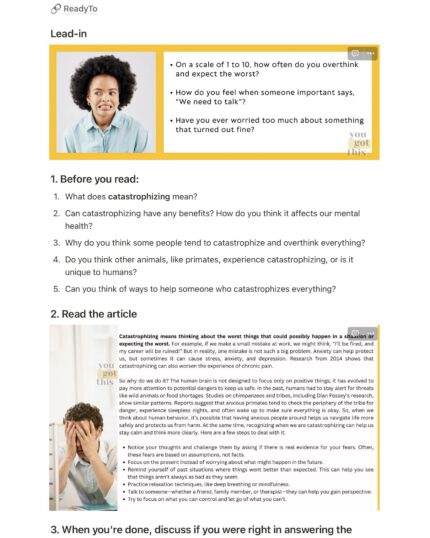
Speaking: Catastrophizing
In this speaking club your students will:
- Break down the concept of catastrophizing.
- Discuss a short article on the topic.
- Explore what we can and can’t control in life.
- Step into the roles of overthinkers and rationalists.
- Use the emotion wheel to comment on different situations.
- And the cherry on top—discuss best-selling self-help books!
This Speaking Club helps students identify overthinking patterns and take action. Through discussions, real-life scenarios, and an emotion wheel, students will practice responding more rationally and break the cycle. Ready to turn stress into strategy? Grab the lesson now!