

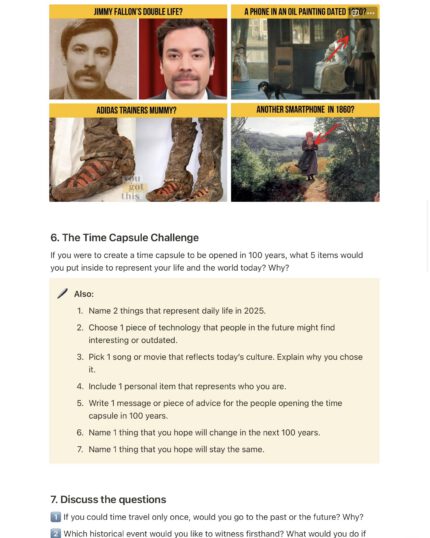
Speaking: Time
Step into a time-traveling conversation that sparks curiosity and deeper thinking. Let your students feel, reflect, and connect through their own perception of time. Dive into nostalgic memories and talk about the things you had as a kid — a Tamagotchi, a collection of hippos from Kinder Surprise?
Speaking Club Highlights
Time Theory: how we feel time vs. how we measure it
Truth or Trick?: debating viral time traveler photos
Time Capsule: what would you save for the future?
Nostalgia vs. Reminiscence: learning the difference
Childhood Memories: sharing and comparing experiences growing up
Movie Talk: time travel, memory, and mind-bending films
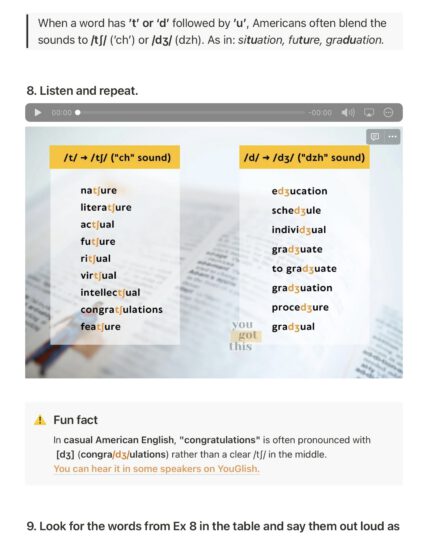
Pronunciation 1. Assimilation
In this lesson your students will:
- Have a good laugh in the warm-up section
- Tune their ears with audio dictation
- Decode “strange” spellings to reveal natural pronunciation patterns
- Practice tricky words with tr- and dr-
- Sort and categorize words by sound patterns in interactive tasks
- Act out mini-dialogues with blended phrases like don’t you → don/tʃu/
- Read a mysterious story while focusing on pronunciation in context
- Take on a homework challenge to spot real-world pronunciation
This lesson contains 12 interactive exercises that raise awareness of features of connected speech in American English and help improve the ability to recognize and produce these features in context.
Skills: American Pronunciation
Features: tr-, dr-, -tu-, /tʃ/, /dʒ/ in Connected Speech
Additional resources: Wordwall, LearningApps

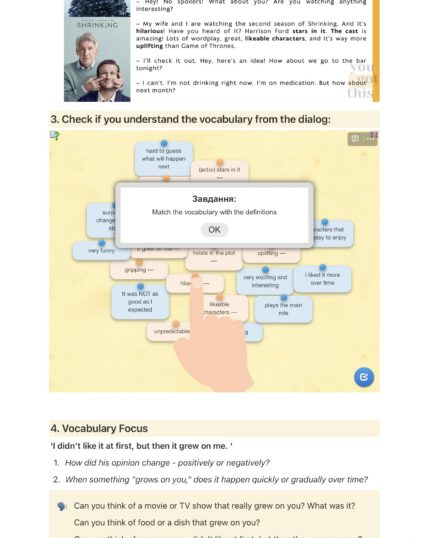
Movies and TV Shows
In this lesson, your students will:
- Talk about their viewing habits and preferences using a real dialogue for context.
- Discover new vocabulary for talking about TV shows.
- Practice pronunciation of commonly mispronounced words.
- Complete grammar discovery tasks on Present Continuous.
- Fill in the verb forms, and identify when the actions are happening.
- Describe real-time and ongoing activities based on pictures and prompts.
- Create their own Present Continuous sentences about their lives and routines.
- Participate in pair discussions and opinion exchanges, using both vocabulary and target grammar.
This lesson contains 15+ interactive exercises that develop students’ ability to use the Present Continuous tense to talk about current and ongoing activities, especially in the context of watching series or movies.
Grammar: Present Continuous for now and around now
Vocabulary: gripping, grew on me, cast, etc
Additional resources: LearningApps, Quizlet

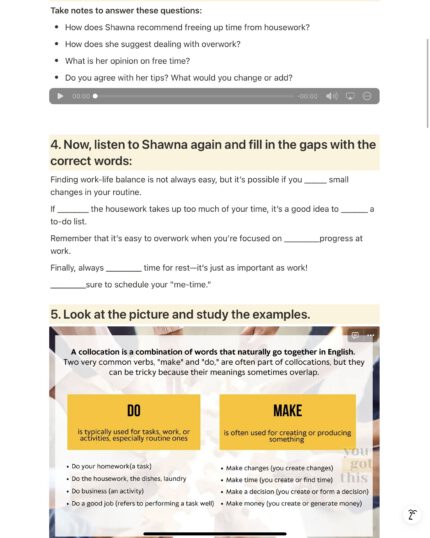
Work-Life Balance
In this lesson, your students will:
- Discuss strategies for work-life balance and give peer advice before listening.
- Listen to a psychologist and take notes on practical advice about balancing work and rest.
- Complete a gap-fill with accurate make/do phrases from the audio.
- Explore and sort verbs into appropriate categories.
- Practice identifying the correct usage of collocations.
- Give advice in pairs using “Make sure…” to respond to real-life problems.
- Correct common grammar mistakes related to the make/do usage.
- Reflect on useful expressions, express agreement or disagreement with key statements, and explain their reasoning.
This lesson contains 15+ exercises that develop students’ ability to understand and use common make/do collocations in the context of everyday tasks and work-life balance, with a focus on listening, speaking, and accuracy.
Vocabulary: do your best, make changes, etc
Additional resources: WordWall, LearningApps, Quizlet
Chores and Repairs
In this lesson, your students will:
- Activate and expand vocabulary related to household problems, chores by matching definitions and objects.
- Identify which professionals to call in various real-life repair situations and recreate short dialogues.
- Practice storytelling and memory recall through structured prompts and discussion of personal experiences.
- Learn and use polite question starters to ask for help and role-play realistic scenarios.
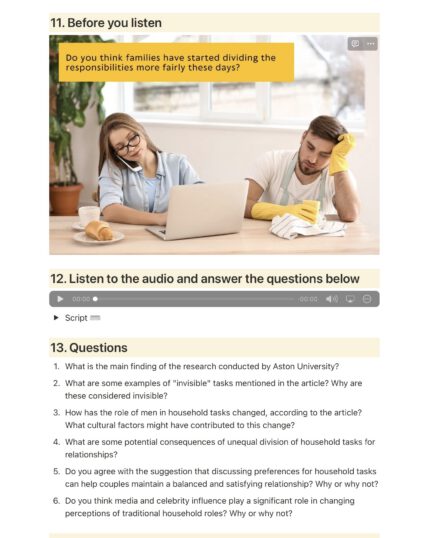
- Listen to an audio and answer comprehension questions about gender roles.
- Clarify and reflect on key statements, expressing opinions on fairness and responsibility in the home.
- Personalize learning by completing prompts and sentence frames to describe their own habits, preferences, and feelings about chores.
This lesson contains 15+ exercises that develop students’ vocabulary and functional language for talking about household problems, repairs, and chores, and improve fluency in asking for help, describing responsibilities, and discussing shared duties.
Vocabulary: clogged toilet, short circuit, fold laundry, etc
Additional resources: WordWall, LearningApps, Quizlet

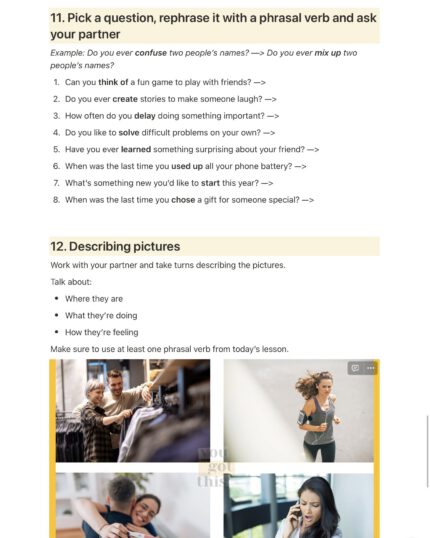
Phrasal Verbs
In this lesson, your students will:
- Explore multiple meanings of phrasal verbs in context and match them to the correct definitions.
- Review and test their understanding of new phrasal verbs.
- Reorder and listen to short dialogs, checking their ability to follow real-life phrasal verb usage.
- Practice gap-fills and matching tasks to strengthen form-meaning connections.
- Categorize phrasal verbs by particles and match them with objects.
- Play a collocation recall game in pairs to build active vocabulary retrieval.
- Transform regular questions into phrasal verb-based questions and interview their partner.
- Describe images using phrasal verbs to connect vocabulary with real-life visuals.
This lesson contains up to 15 exercises, all united by the topic of phrasal verbs. By the end of the lesson, students will be able to: recognize, understand, and use different meanings of phrasal verbs in context, and apply phrasal verbs in both written and spoken forms effectively.
Grammar: Phrasal Verbs
Vocabulary: mix up, figure out, look forward, etc
Additional resources: WordWall, LearningApps, Quizlet

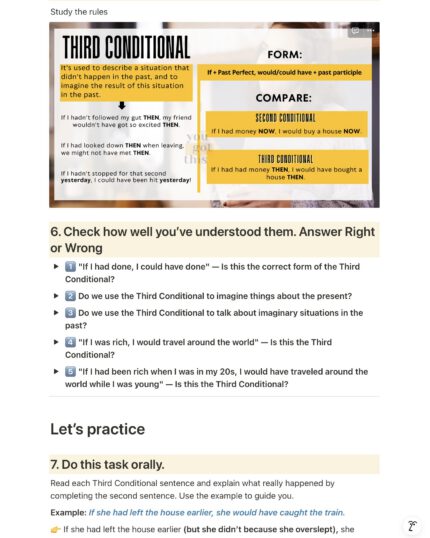
Burnt Toast Theory
In this lesson, your students will:
- Read a short article and answer comprehension and reflection questions.
- Review and match key idioms from the texts to their meanings.
- Memorize and practice mini-dialogues, focusing on accurate language use and idiomatic responses.
- Review the grammar rules for 3d Conditional and test their understanding through a series of interactive tasks.
- Create their own 3d Conditional sentences based on short prompts or their personal experiences.
- Discuss real-life scenarios using new vocabulary and grammar to connect the lesson to emotional resilience and positive thinking.
This lesson contains up to 15 engaging exercises, all centered around a single topic. By the end of the lesson, students will be able to confidently use the 3d Conditional to express hypothetical situations and outcomes in the past and apply new vocabulary and idiomatic expressions related to life’s challenges and surprises in context.
Grammar: 3d Conditional
Vocabulary: bad hair day, hit the roof, count your blessings, etc
Additional resources: WordWall, LearningApps, Quizlet

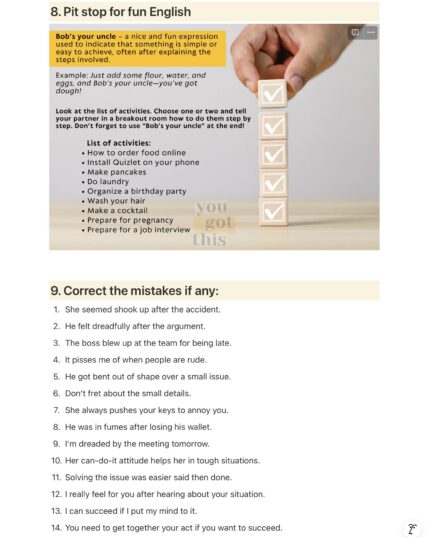
Anger Management
In this lesson, your students will:
- Get a chance to prepare at home by reading an article on four creative ways to manage rage.
- Recall and discuss personal anger management strategies and brainstorm original coping techniques in pairs.
- Review and unjumble key phrases from the article to activate vocabulary and check comprehension.
- Read and analyze a dialogue featuring natural idiomatic language for describing anger and advice.
- Correct common errors to increase grammatical awareness.
- Substitute and upgrade vocabulary to integrate new expressions naturally.
- Practice spontaneous speaking using newly acquired emotional vocabulary.
The lesson features 11 interactive exercises to develop students’ speaking fluency and vocabulary range when discussing emotional self-regulation, using idiomatic expressions related to anger and calming down.
Vocabulary: Blow up, fret about, get a grip on yourself, etc
Additional resources: WordWall, Quizlet

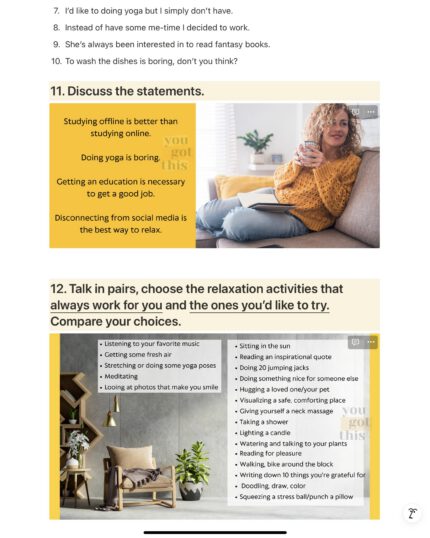
Escapism
In this lesson, your students will:
- Explore the meaning of escapism and brainstorm its pros and cons.
- Activate topic-related vocabulary through matching and pre-listening tasks.
- Listen to a psychologist explain escapism and identify the order of key questions from the conversation.
- Listen again for detail and take notes to answer comprehension questions in pairs.
- Discuss personal views on escapism and how it plays a role in their own lives.
- Clarify rules for when to use gerunds or infinitives using examples and grammar sorting tasks.
- Apply new language in pair discussions related to relaxation and coping strategies.
This lesson includes 12 exercises, all focused on developing students’ listening comprehension skills in the context of a podcast about escapism, and clarifying and practicing verb patterns (gerund vs. infinitive) through guided discovery and controlled activities.
Grammar: verb patterns
Vocabulary: switch off, downside, binge-watch, etc
Additional resources: WordWall, LearningApps, Quizlet

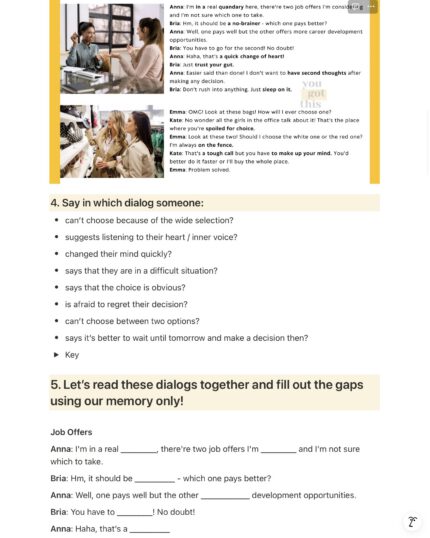
Making Decisions
In this lesson, your students will:
- Review and activate prior knowledge of vocabulary through a word scramble and collocation-matching games.
- Learn and practice key expressions for discussing decisions, uncertainty, and changing one’s mind.
- Use the target phrases in gap-fills and short dialogs based on realistic contexts like job offers and shopping dilemmas.
- Rephrase standard sentences using idiomatic vocabulary, solidifying both meaning and form.
- Create and complete short mini-dialogs, both as one- and two-speaker responses, to practice spontaneous use of new language.
- Discuss important real-life decisions (e.g., marriage, job offers, moving) using newly learned expressions.
- Work in pairs to simulate decision-making scenarios.
The lesson features 10+ interactive exercises that develop students’ productive vocabulary and build fluency in using idiomatic expressions and collocations related to making decisions in realistic, meaningful conversations.
Vocabulary: spoilt for choice, on the fence, a no-brainer, etc
Additional resources: WordWall, Quizlet

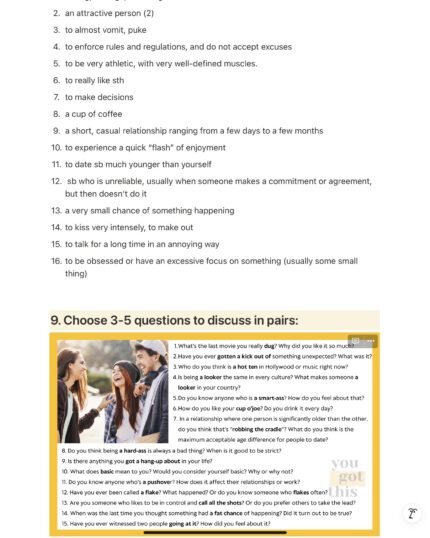
Slang
In this lesson, your students will:
- Reflect on how often they use slang and discuss what makes slang different from other vocabulary.
- Watch a short video introducing common Gen Z slang phrases.
- Match slang words to their standard equivalents to reinforce comprehension.
- Listen to real-life style dialogues that model slang use in natural speech and transcribe what they hear.
- Recreate and act out the dialogues from memory.
- Skim through a short text featuring casual slang in context.
- Identify slang meanings from the text and match them to definitions.
- Discuss slang-related questions in pairs, using the new expressions to describe their own experiences.
This lesson introduces popular slang expressions used in informal English. Through a series of 10 engaging exercises, students explore the meanings and uses of slang terms and gain a deeper understanding of informal language and how to use it in everyday conversations.
Vocabulary: sigma, a hot ten, rizz, fling, etc
Additional resources: WordWall, Quizlet, LearningApps, videos from TikTok and Instagram
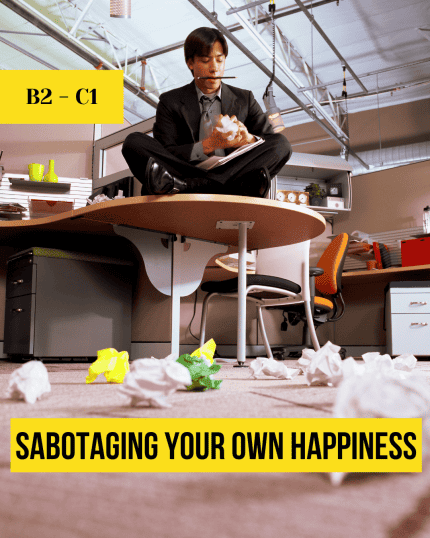
Sabotaging Your Own Happiness
In this lesson, your students will:
- Discuss ways people sabotage their happiness.
- Learn and match key vocabulary.
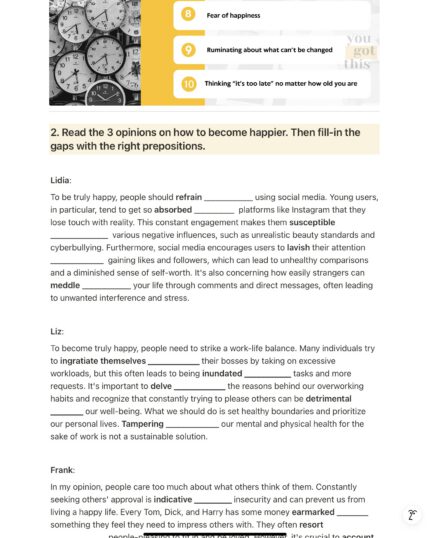
- Read three opinions about happiness and fill in the blanks with prepositions.
- Listen to audio clips to check answers and reinforce comprehension.
- Complete sentences using lesson phrases.
- Reflect on their habits and how to apply insights to daily life.
The lesson features 10+ interactive exercises to develop listening and reading skills for specific information in the context of people’s opinions on happiness and self-sabotage, and improve lexical range and accuracy through focused work on advanced collocations and prepositional phrases related to mental and emotional health.
Vocabulary: refrain from, meddle in, etc
Additional resources: WordWall, Quizlet