

Hustle Culture
In this lesson, your students will:
- Read three short personal stories focusing on vocabulary about routines, stress, and slow living.
- Notice Present Simple and Present Continuous in the texts, discuss the rules, and practice using the corresponding time markers.
- Discuss personalization questions, reflecting on work habits, boundaries, guilt around rest, and work–life balance.
- Expand the topic with burnout, balance, deadlines, switching off, and multitasking vocabulary.
- Listen to a podcast, brainstorm and discuss small everyday techniques to train the brain to relax.
This lesson includes up to 20 exercises that give students the language and confidence to talk about their lifestyle, stress levels, routines, and attempts to slow down using Present Simple/Continuous and key vocabulary related to hustle culture and relaxation.

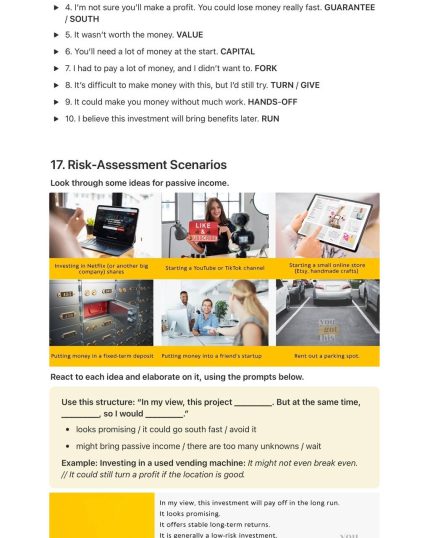
Money 2. Passive income
In this lesson, your students will:
- Build core money vocabulary through prediction, detailed listening, and retelling.
- Expand and personalize vocabulary through context.
- Develop functional language through real stories, noticing language, guided discovery.
- Use the language creatively in dilemmas, debates, and opinion tasks.
This lesson includes 20+ exercises that help students talk comfortably about passive income, understand its pros and cons, and use useful money vocabulary in real-life conversations.

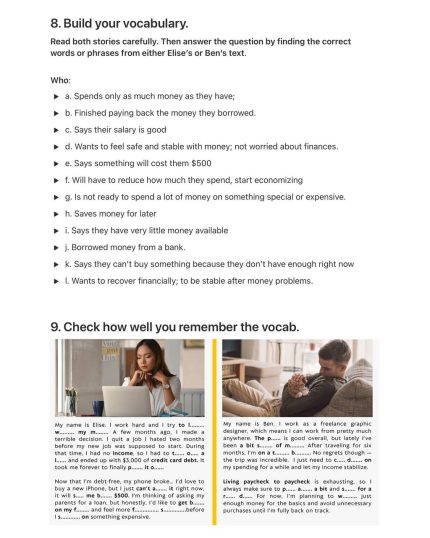
Money 1. Saving and Spending
In this lesson, your students will:
- Cover the basics of borrowing and banking, and practice basic money expressions.
- Reflect on money-related statements and discuss personal preferences and habits.
- Build and personalize vocabulary through context.
- Solve mini-dilemmas about money, ending with a revision game.
This lesson includes 15+ exercises that introduce and practice key vocabulary related to personal finance (saving, spending, borrowing, budgeting) and develop students’ ability to discuss money confidently and naturally.

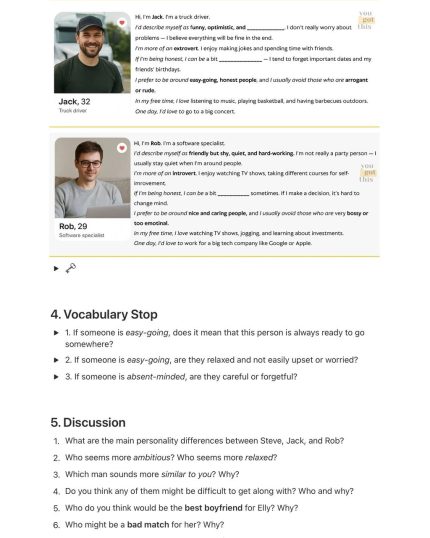
What are you like?
In this lesson, your students will:
- Reflect on their own personality and first impressions.
- Read short introductions of people and identify adjectives describing them.
- Learn and clarify meanings through guided vocabulary tasks.
- Practice using adjectives in meaningful sentences and short conversations.
- Predict which people may get along in life based on their characters.
- Listen for detail to identify traits in people described in short real-life monologues.
- Use personality adjectives fluently in free speaking and discussion tasks.
- Сhoose a well-known character and describe their personality.
- Do several rounds of revision for better memorization.
This lesson includes up to 20 exercises that develop students’ ability to describe personality and character naturally in spoken English using common adjectives and follow-up comments.
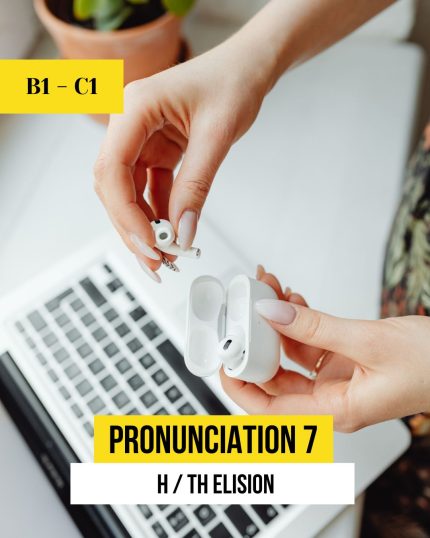
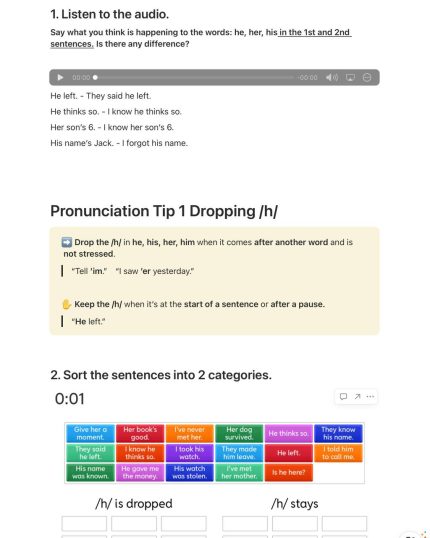
Pronunciation 7. H / TH Elision
In this lesson, your students will:
- Discover how native speakers drop sounds like /h/ and /ð/ in fast, connected speech.
- Notice when and why these sounds disappear through short listening clips and focused tasks.
- Train their ears and polish their pronunciation to catch these reductions through repetition drills and substitution dialogues.
- Put it into practice in a realistic context where they actually use the dropped sounds.
- Start recognizing these patterns in movies/shows, songs, and learn to sound more fluent themselves.
This lesson contains 15+ exercises that raise learners’ awareness of and ability to produce /h/ and /ð/ elision in connected speech, improving their listening comprehension and spoken fluency.

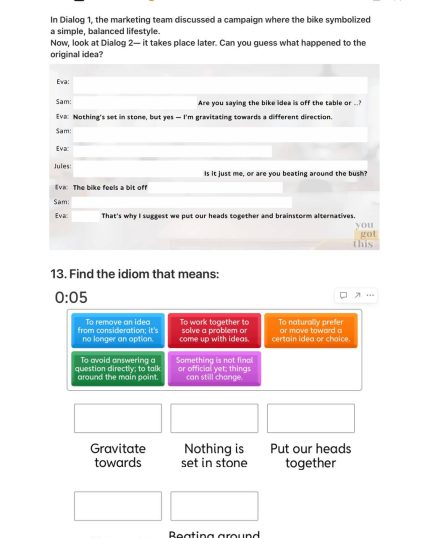
Did I get you right?
In this lesson, your students will:
-
- Brainstorm and sort phrases people use when they don’t understand something.
- Read and analyze a marketing team dialogue packed with natural clarification expressions.
- Check comprehension through multiple tasks — matching, sorting, and vocabulary review.
- Do a gap-fill activity to test recall of target phrases.
- Correct common learner mistakes in the target expressions.
- Transform sentences using target phrases to express the same ideas naturally.
- Play a Taboo-style speaking game: explain simple processes while partners ask clarification questions.
- Test retention by completing a table with all the lesson expressions.
- Continue in Part 2 with a new dialogue introducing idioms*.*
- Do listening tasks — filling in missing idioms and expressions while identifying meaning and tone.
- Practice word stress with verbs like gravitate, simplify, elaborate.
- Complete dialogues using new clarification phrases.
- Use speaking cards and agree/disagree prompts to apply idioms in discussion.
This lesson includes 23 exercises that develop students’ ability to ask for clarification, check understanding, and respond when confused in professional and everyday contexts, using natural conversational phrases and idioms.

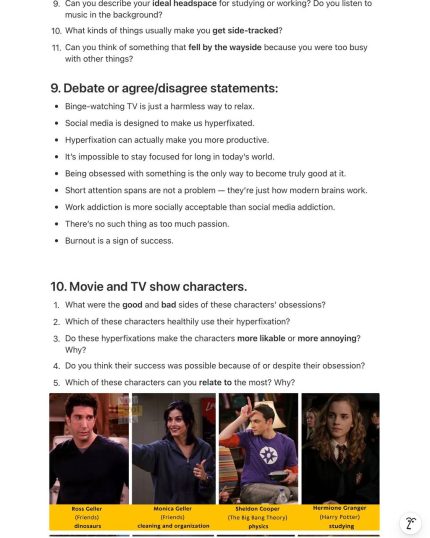
Hyperfixation and Attention
In this lesson, your students will:
- Share what they’re “hooked on” and reflect on their attention span situation.
- Discuss the concept of *hyperfixation* and predict its meaning.
- Focus on vocabulary through a short reading exercise.
- Explore three relatable stories and analyze people’s habits.
- Match quotes with characters, complete gap-fills, and do transformation tasks with target idioms.
- Discuss habits and distractions using idioms naturally in conversation.
- Reflect on statements about productivity, attention, and modern focus struggles.
- Connect the topic to pop culture, discussing movie/TV characters and their obsessions.
- Take the Attention Span Test and reflect on personal focus habits as homework.
This lesson includes 15 exercises that develop students’ ability to understand and discuss the concept of hyperfixation while learning natural, idiomatic expressions for talking about attention, distraction, and focus.

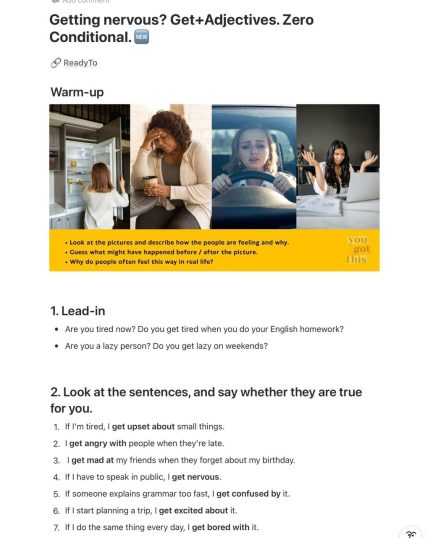
Getting nervous? Get+Adjectives. Zero Conditional.
In this lesson, your students will:
- Explore sentences with get + adjective and check which ones describe them.
- Review prepositions and the difference between if and when, touching on Zero Conditionals.
- Complete sentences with their own ideas and share with a partner.
- Learn to distinguish between states and changes with be + adjective and get + adjective.
- Sort examples, listen, fill in gaps, and create their own sentences.
- Drill mini dialogs with get + adjective.
- Describe feelings in everyday situations and discuss a text about “vacation fatigue.”
- Reflect on emotional reactions and discuss what makes people tired, excited, or stressed.
- Practice an audio drill with get + adjectives for pronunciation and fluency.
This lesson includes 15+ exercises that provide controlled and freer practice of be + adjective and get + adjective structures to describe states and changes of state in everyday contexts.

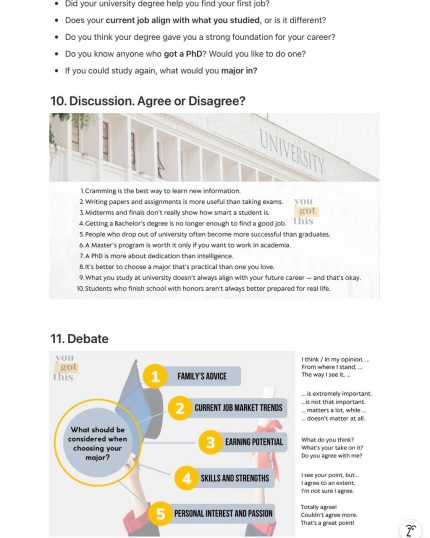
What’s your major? Education
In this lesson, your students will:
-
- Share what kind of students they were and how much they enjoyed studying.
- Watch a short video and practice saying their major.
- Fix common lexical mistakes about education and degrees.
- Listen to a monologue about university life and complete a gap-fill.
- Clarify and practice key academic phrases.
- Compare learning experiences using prompts and speaking cards.
- Debate on factors that play a role in choosing majors.
- Interview each other on their learning experiences, subjects, exams, etc.
- Compare education systems and the flexibility of choosing majors.
- Practice describing educational experience as part of a job interview.
This lesson contains up to 15 exercises that raise students’ awareness of and correct common errors when talking about education and degrees through clarification, controlled practice, and freer speaking activities using key academic vocabulary.

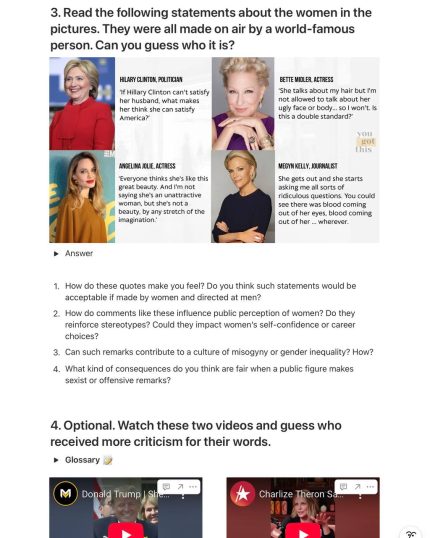
Speaking: Societal Pressure on Women
In this speaking club, your students will:
- Brainstorm and discuss what society judges women for compared to men.
- Analyze real quotes and media examples to see how stereotypes are reinforced.
- Debate whether expectations and criticisms are fair.
- Reframe negative stereotypes into positive qualities.
- Explore how looks may affect women’s career paths.
- Reflect on how stereotypes can change in the future.
- Share inspiring examples of women who broke barriers.

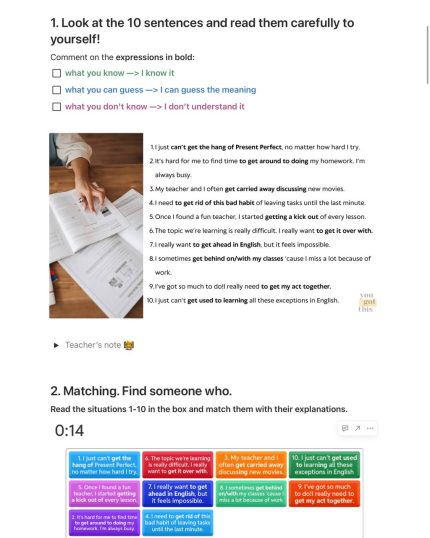
Get the hang of it. Expressions with ‘get’
In this lesson, your students will:
- explore and sort ‘get’ expressions by meaning and usage
- match real-life situations with the correct get collocations
- rephrase sentences using natural get expressions
- test themselves with interactive activities
- personalize language by sharing which expressions apply to their own lives
- practice extending ideas with follow-up phrases for fluency
- watch a short motivational video and connect it to ‘get” vocabulary
- role-play problem–solution tasks using ‘get’ expressions in context
- finish with reflection questions to consolidate the most useful phrases
This lesson contains up to 15 exercises that expand students’ vocabulary by introducing and practicing common multi-word expressions with get, and to provide opportunities for personalization and fluency practice through controlled, guided, and freer activities.
Vocabulary: get a kick out of, get the hang of, etc.
Additional resources: WordWall, LearningApps, Quizlet
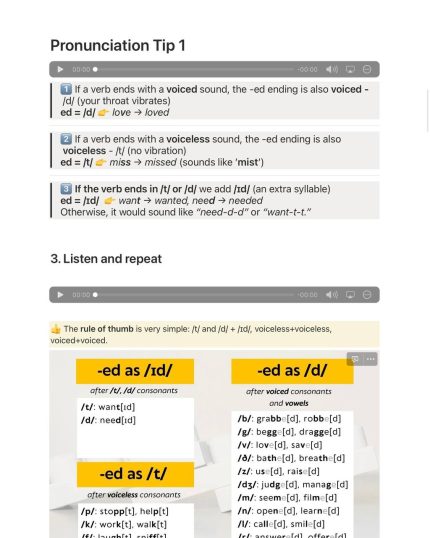
Pronunciation 6. Elision in ‘-ed’ endings
In this lesson, your students will:
- Activate the use and pronunciation of past forms in speaking.
- Test themselves by spotting and trying to correct pronunciation mistakes in past tense verbs.
- Use guided discovery tasks with hints to explore the pronunciations rules.
- Sort and match verbs into -ed ending patterns and practice the endings through listening and repetition.
- Use interactive drills and games to solidify the rules.
- Do semi-free practice tasks to gain more automaticity.
- Notice how native speakers often drop the endings in consonant clusters.
- Compare “clear” vs. “connected” speech versions of past forms.
- Retell a text and speak about their own past activities with attention to -ed endings and natural elision.
This lesson contains up to 20 exercises that develop students’ ability to recognize and produce regular past tense -ed endings accurately and to raise awareness of elision in connected speech (dropping /t/ or /d/ in clusters), so that their pronunciation sounds clearer, smoother, and more natural in fast English.